Archive for the 'Guest Contributor' Category

A Ball, A Box, A Book. . .

Monday, December 31st, 2007

ballboxbook.jpg

Okay, I understand, enough with the holiday theme already. However, as the year draws to a close and you are contemplating the pretty cards on your mantle, consider saving them for one of these projects:

A Ball

ball.jpg

All Free Crafts.com has a tutorial on making a ball shaped ornament out of a card. This is a fun little project that turned out better than I had expected.

A Box

hexbox-copy.jpg

Julie Bolduc has instructions for a hexagon shaped lidded box. I actually didn’t receive enough suitable cards to make this box (16), but it looks like a cool project that you could make out of a variety of papers.

A Book

book.jpg

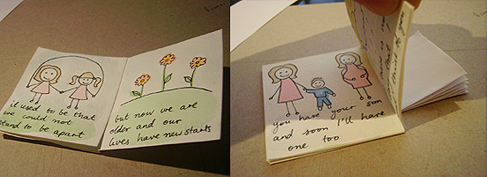
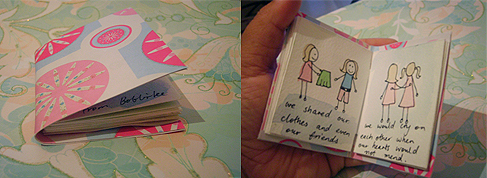
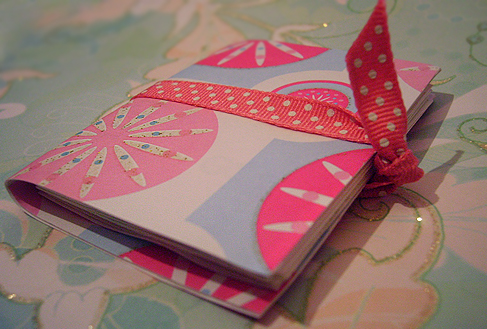
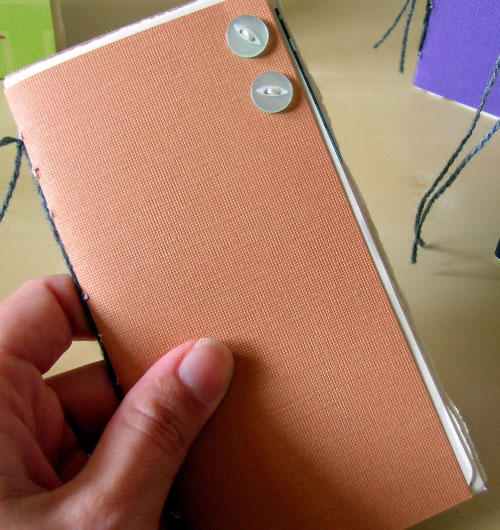
In July, Jennifer shared a guest posting on making a mini journal. You could follow her instructions and create a similar journal using a holiday card as a cover. The book could be left blank, you could turn it into an Advent journal with a little thought or activity for each day, or you could make a special address book for next year’s holiday cards.

A Luminary

luminary.jpg

Kawaii Crafter made these pretty luminaries out of Christmas Cards. I think the picture says it all. They are the perfect thing for dreary days during the next three months, at least in the Northeast.

Other Cool Ideas

star_box.jpg

Jenny Harada made a funky star. It looks like you’ll need about 10 cards for this project.

And here is Diane Gilleland’s popular greeting card gift box as featured on her blog CraftyPod

I hope this is some inspiration to Reuse before you Recycle. Maybe you can make a little something before 2008 begins.

From all of us at Crafty Daisies: Happy New Year!

Pressed Flowers

Thursday, August 9th, 2007

One of the best things about summer is the flowers, don’t you agree? A fun way to keep them around past the peak bloom point (and for those in cold climates to remember the lovely summer colors) is to press them. You can easily make your own flower press, and here’s how.

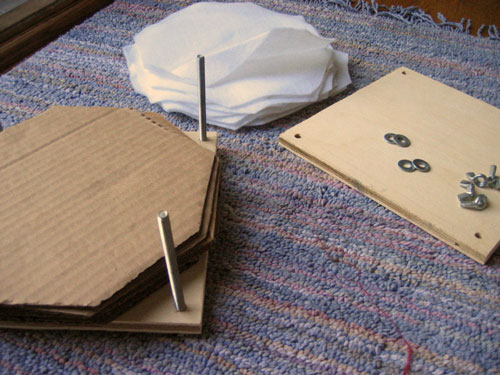
Start with 2 squares of wood (approximately 8″ across), 4 bolts (approximately 4″ long), 8 coordinating washers, 4 coordinating wingnuts, and several squares of cardboard and felt, with the corners trimmed. I have 7 cardboard pieces and about 10 pieces of felt - these are used to separate the layers of the flowers you press and to provide cushioning.

flowers1.jpg

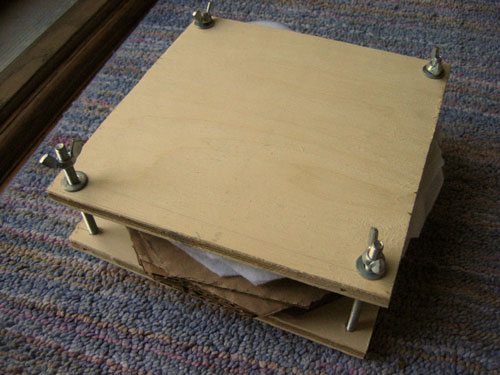
You simply drill 4 holes near each corner of each square and assemble: bolt, washer, one square of wood, cardboard, felt, paper, flowers, paper, felt, cardboard (etc), board, washer, wingnut. You add layers of plain white paper around the flowers to prevent them sticking to the felt, and it also allows for easy storage later on — I keep mine either in a folded piece of paper or inside envelopes. Screw the wingnuts on tight to press the layers together and compress your flowers. Then you wait for a week or so to allow the flowers/leaves to dry and flatten.

flowers2.jpg

Pay attention to the layout of your flowers and leaves when you are pressing - you want to make sure that it will look how you want it to when it’s flat. Leaves are easy, but be careful with multiple petal layers - sometimes they bend oddly when you press them, and the result is not pretty.

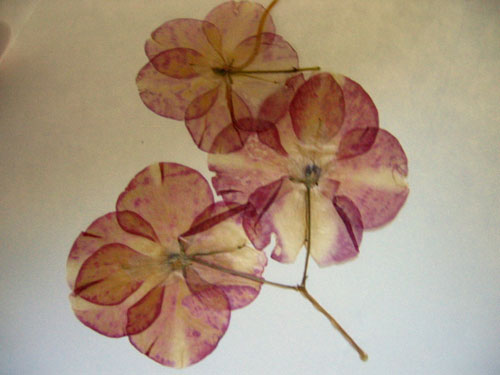
Simple flowers work well though. Pansies are gorgeous:

flowers3.jpg

I’ve also done marigolds, lilac, roses, several kinds of leaves, irises, even a butterfly. If your garden is large, you can have lots of fun playing around with the press and trying different layouts.

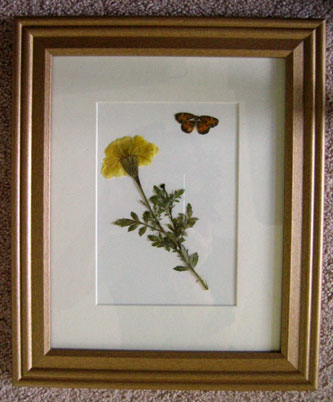
Once you have your array of pressed flowers, you can paste them into a frame:

flowers4.jpg

I just used regular Elmer’s and glued the marigold and the butterfly onto thick white paper (I think mine is designed for painting). Tweezers can be helpful in arranging delicate pieces, such as the butterfly - sometimes your fingers are just too sticky. These flowers would be lovely on cards, too, if you enjoy making your own. Let me know of other fun ways to use them - I’m just beginning my foray into paper crafts :)

This guest post comes from Gina - thanks so much for your contribution, Gina!

Sea shell shadowbox

Friday, July 27th, 2007

Hi, I’m Gina. As do many others, I have always loved the beach. Growing up in Minnesota, though, there are few opportunities to be in the ocean, so I guess I tried to take advantage of all of mine by bringing the beach home with me. Thus I have accumulated a lot of shells, beach rocks, coral, and other beachy finds from various trips, some with sentimental value. For example, one of the rocks I used in the project was from the spot on a rocky beach in New Zealand where my husband proposed.

There are lots of ways to display shells - on countertops, in bowls, etc. But I wanted a way to look at the special ones all at once without them taking up too much space or requiring much dusting. So I decided to create a seashell shadow box.

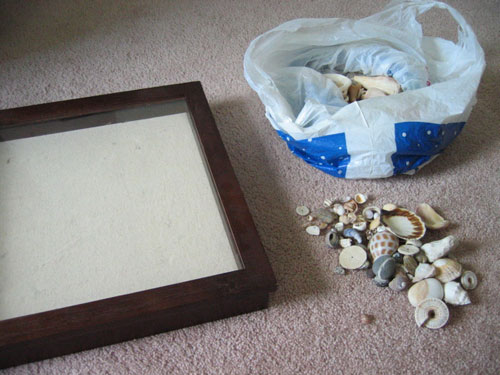
To begin, you need your collection of shells, your trusty glue gun, and a shadow box. Mine has a lovely dark wood frame and a neutral linen background that mimics sand:

shadowbox1_1.jpg

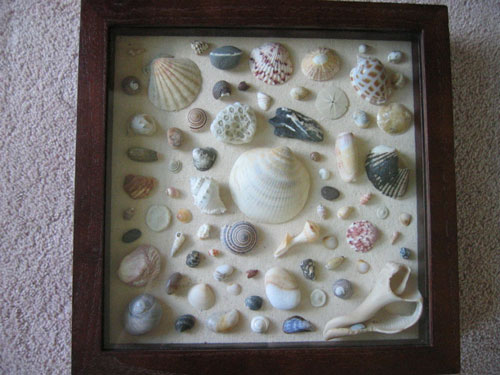
Next, you lay your shells in a pleasing pattern. You could go with a more random arrangement if you like, but I preferred to arrange them so that I could balance shape, color, and size:

shadowbox2.jpg

Then you glue! Most of mine were light enough not to require much glue, but obviously rocks or large, heavy shells will need more. Make sure when you’re gluing (and when you lay everything out) that your shells all fit when the lid is closed. One of mine (the large on in the bottom right corner) was oddly shaped and would only balance on one edge, so I paid attention to that while gluing to ensure I glued the correct edge.

shadowbox3.jpg

I love the finished product! I had tons of shells left over, but I liked keeping some space between the shells. I think a tighter arrangement could also be lovely, though.

shadowbox4.jpg

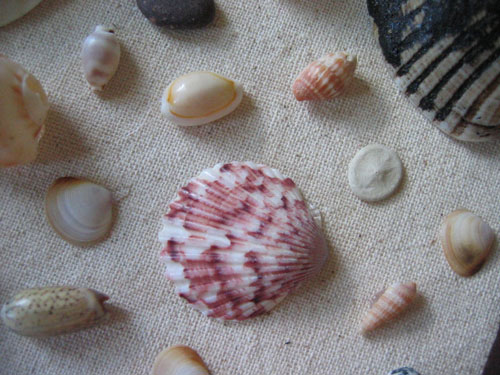
Here are close-ups of the shells and the linen background of the shadow box:

shadowbox5.jpg

shadowbox6.jpg

So have fun with your shells! I’m sure everyone has a collection of sorts that would fit nicely into a shadow box, even if it isn’t seashells.

Recycling Plastic Bags

Wednesday, July 18th, 2007

Mr. McGuire:I want to say one word to you. Just one word.
Benjamin: Yes, sir.
Mr. McGuire: Are you listening?
Benjamin: Yes, I am.
Mr. McGuire: Plastics.

–The Graduate

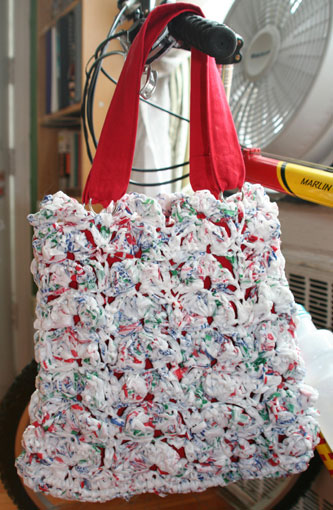
My name is Simone, and lately I’ve become completely obsessed with plastic shopping bags. I think it started when I couldn’t stuff another bag into the bottom of my holder without pushing fifteen more out of the top. On the other hand, I also could not bring myself to toss them because, after all, they were perfectly good bags. I then stumbled upon crocheting strips of plastic into, you guessed it, another bag. Since one tote-sized, crocheted bag takes at least 30 to 50 shopping bags, this project did make a dent into my collection.

tote-bag-2.jpg

Oft cited My Recycled Bags.com provides excellent instructions on how to prepare recycled plastic yarn from shopping bags and shares some crochet patterns for this kind of yarn. Once you have a ball of plastic “yarn,” you can also mix it with other materials. For example, I made this bag by alternately crocheting rounds of plastic yarn and yarn made out of denim strips.

round-purse.jpg

I think it would be kind of fun to follow the Daisies’ crochet instructions, make different kinds of plastic squares, and sew them all together into. . . a bag. (If anyone can come up with something else to crochet besides a bag, please let me know. A rain poncho perhaps?)

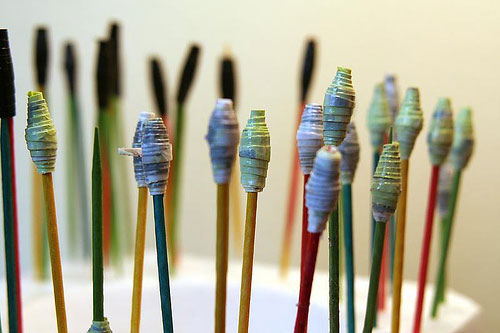
Recently, I saw a posting about fusing plastic bags to make a plastic fabric. That inspired me to make plastic beads out of fused plastic bags.

beads.jpg

You use the same technique you would apply to making paper beads, i.e. cut a triangle out of the “fabric” and roll it up from the broad to the narrow end. You may encounter more resistance from the plastic than you would from paper. I first roll up a bead without applying glue. I then unfurl the bead, apply the glue (Uhu Mosaic) and roll it up again. Like paper beads, you can leave the bead like that or apply a layer of lacquer.

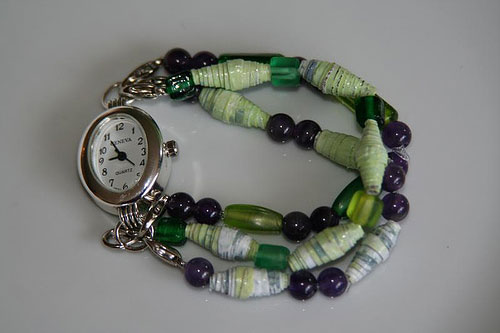
watch.jpg

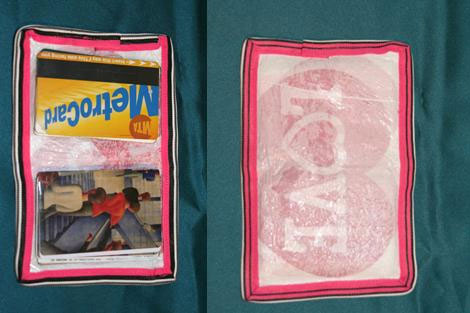
Lastly, I decided to make a wallet out of two ‘I Love NY’ bags and a white trashbag without any print on it.

wallet.jpg

* I fused the three bags together and cut out a 6 1/2″ x 4 3/8″ rectangle.
* I then cut out two 4 3/8″ x 2 5/8″ rectangles out of clear vinyl left over from some bedding packaging that I had saved for just such an occasion. These will become the inside pockets on the left and the right side of the wallet.
* I then basted the pockets to the left and the right of the rectangle with a glue gun to keep everything in place.
* To finish it off, I trimmed the wallet with a 31″ long piece of 7/8 inch ribbon. The ribbon is folded in half and sewed on around the wallet through the fused plastic and the vinyl with a top stitch.

Start to finish the whole project took me a little over an hour. You could add a velcro closure to the wallet to keep everything in place, if you don’t stuff it with as many random pieces of plastic as I tend to do.

Now I’m worried that New York will encourage businesses to cease the use of plastic bags. In that case, where will I get my raw materials? Have fun with plastic. Let me know if you have any other ideas of what to do with this stuff.

Making your own mini journal

Thursday, July 5th, 2007

mini-books.jpg

My name is Jennifer, and I love all things having to do with paper. But recently journals that I see in stores just haven’t been doing it for me. I don’t want just lined paper, scrapbook paper or watercolor paper… and I don’t want 15 different journals going all at once (though I must stress I have no problem with owning 15 journals at one time).

With this in mind I started to ponder making my own book. What better way to solve my dilemma than to make something with whatever kind of paper I wanted. I started to read and read on book binding, but I didn’t want to invest in an entirely new hobby, not yet anyway… I simply wanted to try it.

So I took all of this information that I gathered and made my very own mini journals. My supplies were as follows:

  • ~ paper (of all kinds)

  • ~ ruler
  • ~ yarn
  • ~ embroidery thread
  • ~ sewing and embroidery needles
  • ~ a Popsicle stick
  • ~ heavy books (I used Shakespeare’s Complete Works and a Norton Anthology)
  • ~ buttons
  • ~ other random crafty bits

I picked my size of paper (6×6 in this case) and cut the paper I had chosen to fit. I used all sorts of paper… from notebook paper to fancy scrapping paper to card stock. I also ended up using multiple sizes of paper- some 3×3 or 4×3. This created an interesting layering effect in the finished journal.

open-books.jpg

Once I cut my paper I folded it in half using my trusty Popsicle stick to make a proper fold. I then used my ruler to measure and punch 8 holes in the center of the fold. I used the needles to make the holes. Then came the fun bit of assembling the book. I put the paper together and then used my yarn and embroidery needle to sew the book together. Once it was together I placed the book under the heavy books and waited…… The next morning my lovely little journals emerged in all their splendor. I then used buttons, paper and chip board letters to decorate the covers of the journals.

blue-buttons.jpg

I may end up becoming more serious about book binding at some point, but for now this is a lovely and inexpensive way to try your hand at book binding and to have a journal that is uniquely yours.

To learn more about the proper way to bind a book take a look at this website, which is truly informative and offers some excellent tips that can be used in any paper binding experience.

Make your own paper

Thursday, June 28th, 2007

Hello. My name is Joanna and I’m a paper addict. I hoard paper of all kinds. I do not discriminate against any texture, type or color. I love it all and never knowing when I might need it for a project, I keep it all. When I can no longer keep track of all the scraps, I know I must do what any self-respecting paper addict must do - make more paper! Here’s how I go about it.

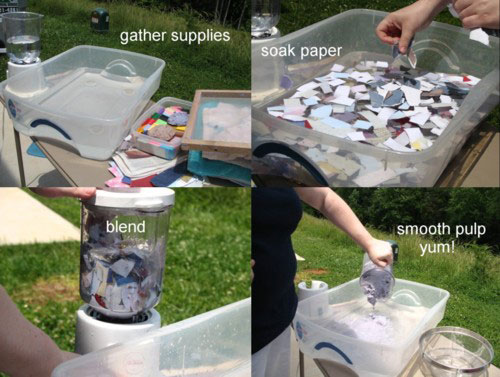
First, gather your supplies:

  • ~ Paper scraps with a matte finish (newspaper, tissue paper, construction paper or junk mail but try to avoid the glossy ads)
  • ~ Several towels you don’t mind getting dirty
  • ~ Blender
  • ~ Deckle (this is what you use to strain the pulp, more on that later)
  • ~ Container large enough to fit your deckle (my deckle makes a letter sized sheet of paper so I have found a large plastic storage bin works for me)
  • ~ Sponge
  • ~ Iron (optional)

To begin, you have to make your pulp:

1. Fill your plastic container with several inches of water. You need enough to submerge the deckle completely.

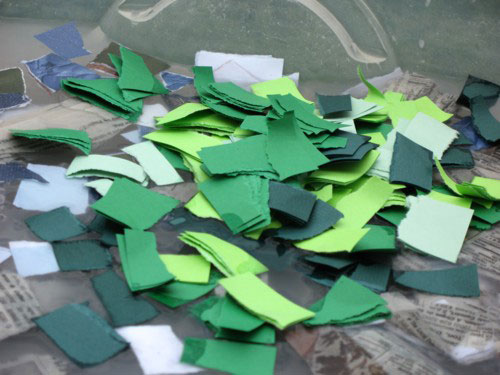
2. Tear your papers into small pieces about 1 inch square and add to the water.

3. Let soak until all of your pieces are completely wet. Any dry pieces will not break up entirely and will leave specks in your finished product. This can be desirable so feel free to vary your soaking times until you get the look you want.

4. With the blender 2/3 full of water, add your soaked pieces of paper and blend until smooth. This also varies the look of the finished product so feel to play with your blending times. Just remember that the smoother the pulp, the smoother the finished product.

5. Return processed pulp back to the plastic storage bin, stir to evenly distribute.

cd_jm_tutorial-1.jpg

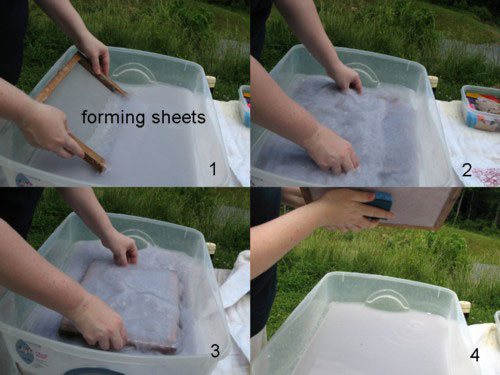
Next, you need to form the sheets. The shape of your deckle will determine the shape of your paper. I purchased mine at my local craft store but you can also make your own by using window screen stapled to a wood frame. I have never tried this so let me know how it turns out if you do!

1. Hold your deckle at an angle as you slide it into the pulp mixture. I go straight to the bottom of the container.

2. Swish it around while it’s submerged. This ensures an even layer of pulp covers the deckle.

3. Keeping the deckle horizontal, remove it from the water and let it begin draining. At this point you can move the pulp around if you need to.

4. Using the sponge, wipe across the screen side of the deckle to remove excess water. Take care how much you tilt the deckle as the pulp can still slide around.

5. I set my deckle on the side of the container to drain while I get the next step set up.

cd_jm_tutorial-1-1.jpg

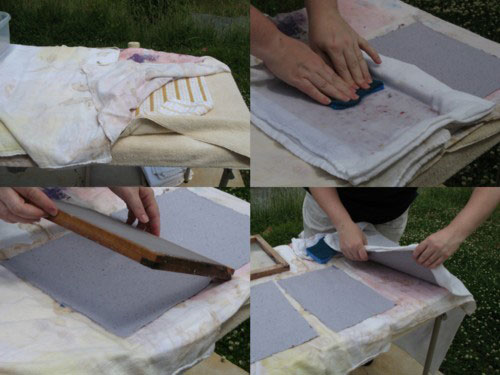
The next step is called couching (pronounced cooching)

1. Place a layer of towels on your surface.

2. Place the deckle screen side down onto the towels.

3. Lay another towel over top of the formed sheet (will be against the pulp) and press with your hands and the sponge to remove additional water.

4. Turn out sheet onto first layer of towels. Sheet should be dry enough to just fall off the deckle. If not, flip and press again. If this makes you nervous, leave the towel on the pulp and turn out the sheet onto it.

5. Layer sheets between towels and press to remove additional water.

6. Remove sheets and lay flat to dry.

cd_jm_tutorial-2-1.jpg

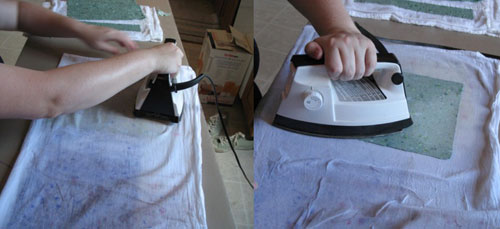
The last step is drying the sheets with an iron (which is optional). I like to iron my sheets dry not only because I’m horribly impatient but because the iron gives the paper a smooth finish.

1. With iron on high, start ironing the wet sheet while still sandwiched in between a towel.

2. Iron until towel starts to feel dry (enjoy the steamy facial in the process!)

3. Pull back top layer of towel and iron sheet itself. When the iron skips right across the sheet you’ll know it’s ready to be ironed directly. It will stick and pull the pulp if it’s not ready.

4. Iron until sheet is crisp and dry.

cd_jm_tutorial-3.jpg

A note about colors:

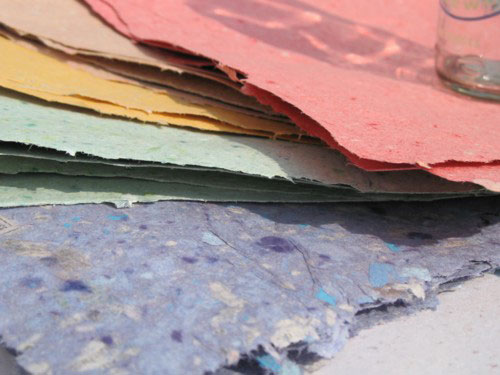
The pulp will always be a few shades darker than the finished product. I like to use solid colored cardstock or tissue paper color the pulp. Since it’s heavier, the cardstock adds a nice speckle to the finished paper. Take care when using strong colors as the dyes can stain clothing.

cd_jm_tutorial-4.jpg

Clean up:

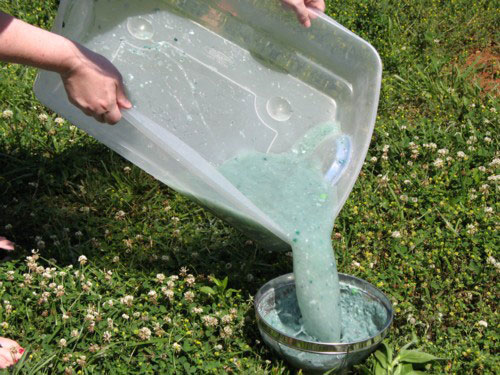
I like to do this outside because I make a mess whenever I do anything crafty. Since I’m already outside, I just dump the any left over pulp mixture in the yard when I’m finished (the pulp hangs around for a bit so choose an out of the way place for this). If you’re inside, strain the mixture before dumping it down the drain. Even outside, sometimes I will still strain it to save the unused pulp, especially if I liked the color. Once strained, press the pulp to remove as much water as possible and then let dry. The resulting chunk can be broken up and added to your next batch or add some white glue and sculpt with it!

cd_jm_tutorial-5.jpg

Here’s a sample of a few different textures and colors I’ve made recently. I simply varied the weight of the paper and how long it was processed in the blender.

cd_jm_tutorial-6.jpg

Last call

Friday, June 1st, 2007

This is the last call for anyone who is interested in doing some guest-posting for Crafty Daisies. Our beloved Joy is heading to Nogales, Mexico for an amazing ministry opportunity, and admist her absense we’ll need some help filling in the gaps. The gig doesn’t pay well (okay, like at all), but you’ll get tons of love and affirmation from us and others who read the site. And we’ll send you a lovely parting gift from one of the lovelies at Crafty Daisies. So if you’re interested, please shoot me an email (gals@craftydaisies) and let me know.

Flannel Quilts

Thursday, April 12th, 2007

First of all - I want to thank the girls of Crafty Daisies for inviting me to guest blog this week! I don’t get the chance to blog about crafting very often, but I love to craft/sew/knit/etc! So I’m looking forward to sharing some of my projects with the readers here at this great creative space!

As an avid reader of Crafty Daisies, I have noticed a lack of quilting posts thus far, so I thought I would post about some of my quilting projects. I started quilting about two years ago, teaching myself out of a book - Quilting 101: A Beginners Guide to Quilting (one of the current reads on this blog!!). I highly recommend this book for beginning quilters. If you do not have a lot of sewing experience, it gives you a rundown on how to use your machine. It is spiral bound and opens easily for use while sewing. Also it is full of some great and easy quilting projects to get you started.

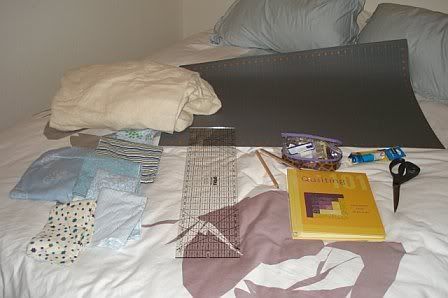
As usual, when starting a new hobby, I had to get all of the equipment. Quilting requires you to buy quite a few things that I, at least, did not have on hand in my sewing materials:

Quilting Equipment

Cutting board, special ruler, special pencils and pins, rotary cutter, book, tons of batting, and fabric!!!!!!! One of my favorite things to shop for.

Since I already knew how to use my sewing machine, I skipped a lot of the easier projects, like quilted pillows and potholders, and jumped right into my first quilt - a flannel lap quilt. And I fell in love with it! It is such a fun project. The whole thing can be put together in just a couple of days. Also, when you buy the fabric the first time, you end up with enough for the top of two quilts, which is great!

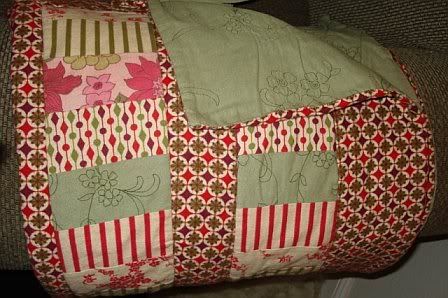
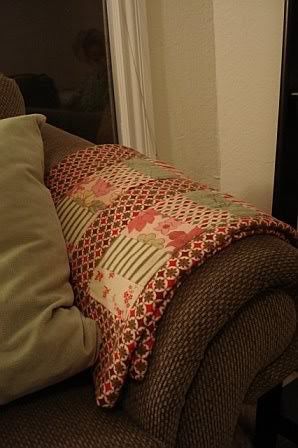
I started off making a quilt for myself:
pink quilt

I fell in love with all of these great, pretty, pink and red flannels. The quilt is really warm, cozy, washes well, and looks great on my couch!

pinkquilt2

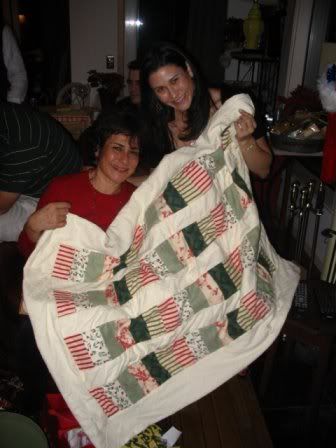
I loved making this so much that I made several as gifts for others. I made one for my Aunt for Christmas, in reds, greens, and whites/creams (edited to add that I am not in that picture - my Aunt and Cousin are holding up the quilt):

xmas quilt

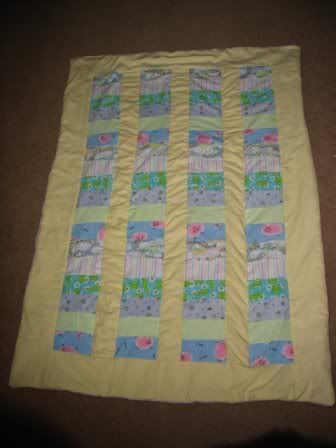
And one of my favorites, a baby quilt with a barn animal theme:

baby quilt

Hard to see in the picture, but there are patches of pigs, lambs, frogs, and ducks. So cute and the baby now drags it around, which I love to see!

So that is my first adventure in quilting. I recommend trying something out in flannel - it is really cozy and there are a lot of fun prints you can use. Plus the fabric is pretty forgiving! Puckering around seems is part of an old-fashioned looking quilt, especially in flannel, so minor mistakes just add to the charm of the quilt. I hope to work on some more complicated projects in the future, but I think this was a great first quilting experience!!!
Emily