Archive for the 'Sewing' Category

Little House in the Big City

Friday, April 4th, 2008

img_9072web.gif


Remember Little House in the Big Woods by Laura Ingalls Wilder? While I was making this afghan I was reminded of all the craft projects described in that book. I thought that this would be the sort of thing that Laura’s mother would put together for her girls as a Christmas present (except it wouldn’t be cashmere, and the sweaters wouldn’t have originated in China, and [fill in the blank]).

So, these are the steps I followed to put the blanket together:

Materials

  • 3 sweaters — The final product measured 42″ x 52 1/2″. You could felt the sweaters, but I wanted to maintain the light, airy feel of the original knit.
  • Bias tape or scrap fabric to make your own tape
  • 8 1/2″ x 8 1/2″ template to cut out the squares. (Guess why it’s that size :))
  • Lots of thread (zigzagging takes way more thread than I had anticipated)

Step One

Cut out 30 squares. I wanted to show off some of the details of the sweaters. Consequently, I included side seams, shoulder seams, ribbing, and pockets in the squares.

mosaic2125613web.gif

Also, don’t forget that the “wrong” side may end up being the “right side.

Step Two

Lay out your design.

Step Three

Sew. Using a zigzag stitch at the widest setting, sew together strips of 6 squares each abutting the edges. You could also overlap the edges, whatever technique you prefer.

img_9043web.gif

Next, put the 5 strips together by first joining the “intersections” of the squares and then sewing down the length of the strip. You now have a 5 x 6 square blanket.

Step Four

Finish the edges. Originally, I intended to blanket stitch around the whole thing. Then I watched Amy Karol’s Bias Tape tutorial, read about this nifty tool on Alicia Paulson’s blog Posie gets Cozy and decided to make my own tape.

img_9060web.gif

This is a 1/2″ tape maker. They come in different sizes, but this is the only one they had at my corner store. You cut up your fabric to the requisite width, feed it through the tape maker and it comes out perfectly folded on the other side. You then fold the tape in half and iron it flat.

Next, you open up your store bought or home made tape (see Amy’s tutorial for the finer points of sewing on store bought tape) and align the edge of the tape to the edge of the blanket. Sew along the line created by the fold closest to the edge.

img_9051.gif

For instructions on how to create mitered corners, follow Alicia’s tutorial.

Once you’ve attached the binding to the edge, flip the binding over to the other side and top stitch alongside the folded edge.

img_9096web.gif

That’s it.

You can add an appliqué or two if you wish or just leave it as it is.

img_9085web.gif

I’ve set up a Flickr group where you can share your creations at www.flickr.com/groups/sweaterblankets/.



Tea Towel Apron II

Thursday, March 13th, 2008

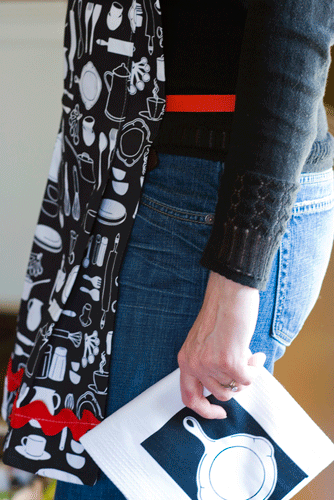
This really cute towel screamed Apron to me and it was so easy to make!

apron-1-cd.gif

This towel set came folded in thirds so I used the pleats to narrow this towel to better fit as an apron. I made a 2″ overlap from the pleat on the right and left and pinned the neck strap within the pleats. Then sewed across the top, securing the neck straps. Next I measured 15″ down from the top and sewed down the pleats. This left it to flair like a skirt a little at the bottom.

apron-side-cd.gif

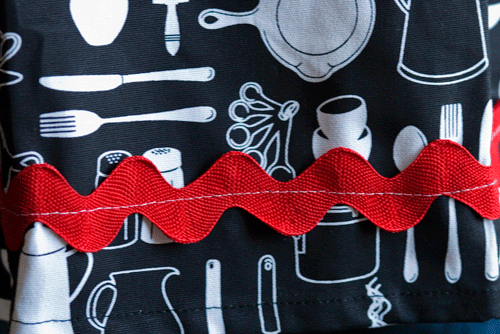
I tucked the ric rac ends under on the back side and sewed down the middle of the ric rac on the front. This would be such an easy way to make any color combination to match any kitchen.

apron-detail-cd.gif

I used grosgrain ribbon for the waist ties. I burned the ends slightly so that they wouldn’t fray and just sewed on the back side along the edge seam higher than where the sewn pleat ended. Super quick and easy!

This apron can be found at my shop in black and red.

More Crafty Thriftiness

Monday, February 25th, 2008

When I was in elementary school my mother would extend the life of my jeans with a piece of jacquard trim. As an eight-year old I hated it, but now in the age of craft and retro design what could be cooler than a personalized pair of pants.

img_8738small.jpg

So, when my daughter began to outgrow her much loved khakis I began my hunt for some trim. Luckily our local notions store had a stack of it. I decided on three different kinds and bought a yard of each. The trim should be at least two inches wide to get a noticeable extension of length. To ensure my daughter’s buy-in, she decided which trim would go with which pants and we were on our way.

img_8757small.jpg

To attach the trim, you measure the perimeter of the leg bottoms and add two inches to that number. In my case the perimeter measured 13 6/8″ plus 2″ equals 15 6/8″. Cut two pieces of trim to this length.

img_8765small.jpg

To clean up the cut edges, fold over a half inch at each end and zigzag stitch across the width of the trim.

img_8766small.jpg

Then attach the trim along the line of the bottom leg hem allowing for an inch of overlap at the inner leg seam.

img_8771small.jpg

Once you’ve come full circle, sew together the overlapping ends of the trim.

img_8775.JPG

Finish with a few stitches across the bottom of the trim overlap.

img_8752smaller.jpg

Should you have some leftover trim as we did, you can fashion a stylish and quick headband by attaching 1 inch wide braided elastic to each end of the trim.

Sham Pillow

Friday, February 15th, 2008

I can’t believe how expensive decorative pillows are to buy!! We recently moved and I want to change some of my old pillows with new colors so I headed to my favorite aisle for inspiration- the clearance aisle at TJMaxx.

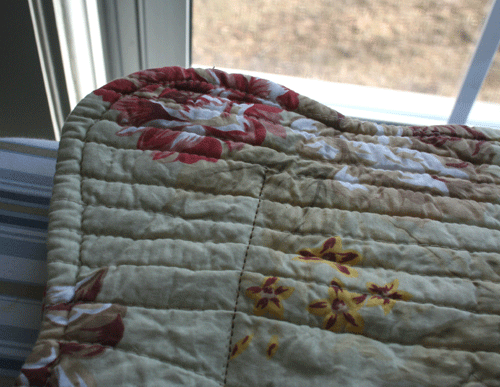
sham-pillow-finished.gif

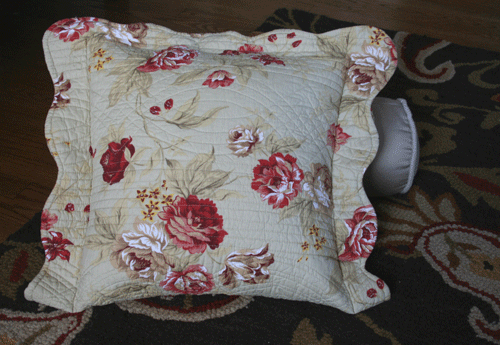
I found a single king-sized sham to make a cover for my old couch pillow. I like using shams because they are already lined, thick, and since they are quilted already have style to them. I also like to be able to take the pillow cover off and wash it since we snack alot on our couch. The sham was so long that I could fold it in half and perfectly surround my old pillow.

To make your own:
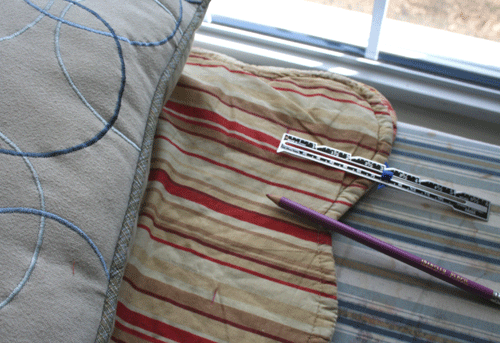
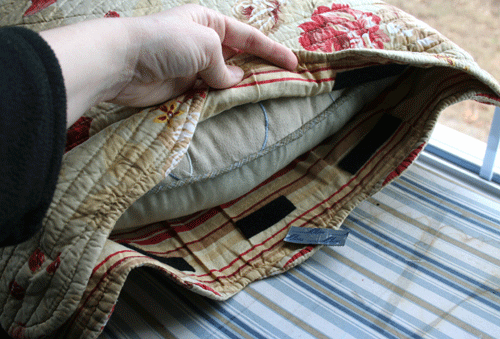
1. Fit pillow (or make one desired size) and measure how far in to make the seams. I made a mark all the way down with chalk. I liked the striped fabric the inside was lined with and the scalloped edges, so I decided to sew the seams on the right and left on the right side of the pillow sham, stopping a few inches from the top. This left a slight flap so I could see the reverse lining. (do not sew on the wrong sides as I marked to do here!)

sham-pillow-measure.gif

2. Sew down chalk line on top (right side) of sham, or on reverse side if you want to turn it inside out (like making a normal pillowcase).

sham-pillow-edge.gif

3. Measuring down on the inside along the top I used adhesive strips of velcro every few inches to attach at the top. Even though this doesn’t need to be opened every day I am going to now sew a line down the middle of the velcro because it hasn’t stuck as well as I’d hoped.

sham-pillow-stuffed.gif

I liked that this was $5 update and the recycling of my old pillow!

Bling, Blong, Merrily on High

Friday, December 14th, 2007

8160small.jpg

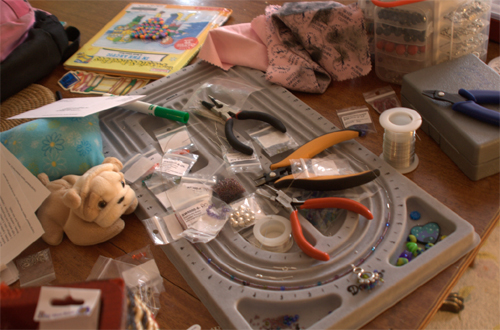
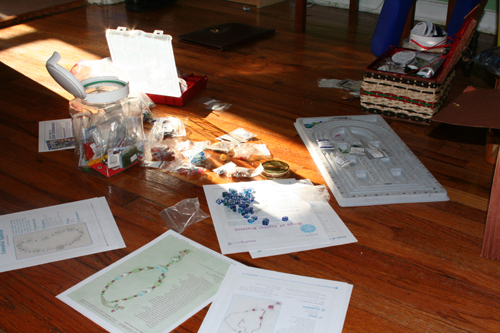
Reporting directly from Santa’s workshop: It’s a mess. Do you craft on the floor? I often do. It tends to be the last available spot for me to spread out since most of my table tops are covered with last month’s homework and advertisements. Also, when you’re beading the beads won’t roll off the table. (duh :))

img_8158small.jpg

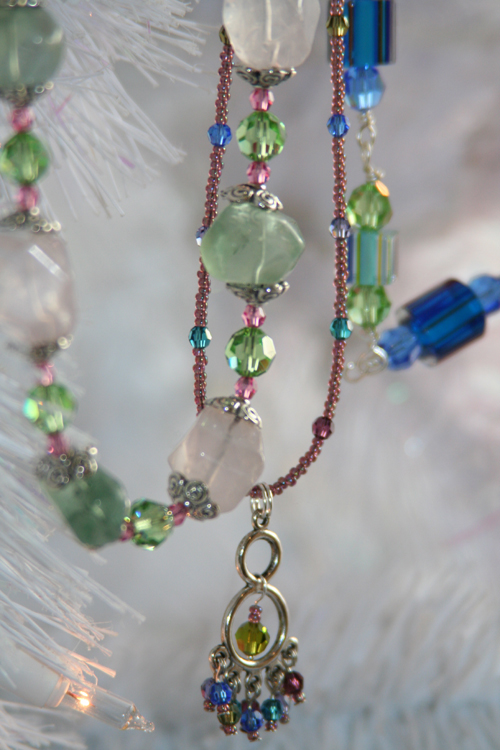
Given the current state of affairs at my household, my extreme handmade gifting pledge (I will only give handmade presents made by myself) will probably only extend to the female members of the family. The nice thing about making the kind of jewelry I’m capable of putting together is that it only takes a very finite amount of time. After one hour I feel like I was creative and actually finished something. For inspiration, check out Beading Daily. For how-to’s I like Rachel Nelson-Smith’s site. After following her tutorial on how to form a basic loop, I finally got it!

So who will get these pretties?

img_8177small.jpg

Towel Turned Apron

Friday, September 21st, 2007

fruity-apron-11.gif

Though I love the first apron I made, I found a much quicker formula. I simply converted a kitchen towel into a full apron. This is a quick 30 minute project and who can resist with such cute prints out there!

fruity-apron-set-2.gif

First, Run a needle and thread in and out evenly very close to the trim and draw it to the tightness of gathering you like. I loved this towel because it had the rust colored trim on the top and bottom already.

fruity-apron-4.gif<

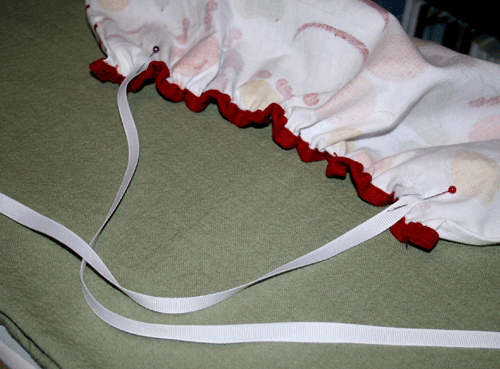
Then pin your ribbons (20") in place and sew over the gathering, making sure it IS wrinkled under the needle and that the fabric doesn't flatten out. I also burn the edges of the ribbon with a lighter so that is does not unravel, very lightly so you don't change the color of the ribbon.

fruity-apron-3.gif

Last, I measured 2 ribbons 28" inches long and measured where at my waist I wanted to tie the apron. Again, I burned the ends of the ribbon and pinned them into place along the back right and left edges of the towel and sewed just over the ribbon, along the original towel seam.
Voila! So cute and automatically comes with a matching towel! This would be a great, quick, housewarming gift!
If this fruity set is perfect for your kitchen I have a couple of sets available
here!

Chair Makeover

Tuesday, September 18th, 2007

This was one of those projects I put off for 2 years and only took one day to complete: recovering the cushions on our dining room chairs.
Here is one of the chairs previously, with large, off-white cushions, spotted with circles and stains and one year old handprints.

old-chair-1.gif

I bought a remnant piece of fabric without measuring the piece or the chair cushions (impulse buy!) but I liked the fabric a lot and it was only $6 for the whole piece. When I got home I saw that it was about 3″ too narrow to work! So I bought brown lining fabric and sewed a 2″ strip onto the right and left sides. This gave me just enough width to fit these very large seats. I bought brown rather than white lining so just in case it showed on the sides it wouldn’t stick out too much. The hardest part was just wrapping the corners and getting it stapled down smoothly. An electric staple gun is a necessity to get the fabric snug with the cushion.

new-chair-3.gif

My living, dining, and kitchen are all in one long row in my house so I wanted to choose a fabric that was a little formal and also brought the colors of all these rooms together. What I liked best about this striped fabric was that it had a gold stripe that complements my yellow dining and living room walls, a brown and rust color that match my kitchen, and a little blue and green too to match the living room furniture. I am much happier with what seem like new chairs to me!

new-chair-2.gif

Sewing Even Corners

Thursday, September 6th, 2007

Can you notice a difference between the corner on the left and right?
corner0.gif

In an attempt to go a little more green around our house I decided to make up a bunch of cloth napkins in fabrics I liked. The only frustrating part was trying to press, pin, and sew corners that never came out straight. There is always that little corner that sticks out like a tongue at me! Until I learned a better way to fold and sew them, (Thanks Mom!) and I wanted to share tips from my sewing misadventures with you.

1. Snip off a little diagonally in each corner. (You may find this step in unnecessary but it ensures a neater fold as you get to Step 4.)

corner1.gif

2. Pretend that you have not snipped the corner and fold and press a 90′ “triangle”. You want this to be the width of turning your fabric over twice the width that you desire.

corner2.gif

3. Now turn the edge over two times until the sides and ends match up to peak at a perfect triangle. This may take a little trial and error. You can see where I pressed the sides and unfolded the edge again.

corner4.gif

corner5.gif

4. I use an iron to do a lot of my sewing. Ironing really helps you to get your hem straight and with no pins! So once you have this lined up just right you can just sew across your hem.

corner6.gif

I feel great when my homemade napkins look just as good as the ones I have bought! Great for tablecloths, tablerunners, placemats, etc. too.

Sewing Machine Covers

Tuesday, August 28th, 2007

I have never shared with you pictures of my “studio” because until recently I didn’t really have one. But recently I got a great desk from my favorite antique store to put in the corner off of our living room. A permanent, beautiful desk that doesn’t fold up to be put away! Now that I am all organized with my shelves of baskets and matching bins I really want to work to keep it an attractive corner of our house. But as much as I love my sewing machine I don’t want to look at it all the time. So I made this pattern for a sewing machine cover.

black-cover1.gif

I made it reversible and heat bonded the two fabrics together so it would stand stiff. Then sewed bias tape around to edge it.
The reversed side:

black-cover-pink-side.gif

The sides tie with ribbon.

black-cover3.gif

open-black-cover.gif

It was fairly easy to make and I love to look over and see fabric that I like rather than just my machine. If you are interested you can buy my machine covers here.

This second cover is made with four panels to cover all sides of the machine and has a handy opening for the machine handle. It has pleated corners and a stripe of velvet trim. This is also available at my etsy store, and look for more colors. I was pleased with these covers which did not take much fabric, and make me smile when I walk by. Here you can get a slight glimpse of my new sewing table! The cover really finished it!

machine-cover-1.gif

cover-detail.jpg


The embroidery school is post-poned until tomorrow, so if you’re following that, please check back tomorrow morning for Lesson 3.

How to Square Bags

Friday, August 24th, 2007

I had been asked by several to explain what I meant by the term “gussetting” in several of my former projects. It’s one of those techniques that is difficult to describe in words but is really easy to do! I promise if you try this quick tutorial it will change the way you sew, especially the way you make bags!

1. For my example I made a small pouch by folding my fabric in the middle (right sides together) to make the bottom of my bag, and sewing up the right and left sides.

square-1.gif

2. Then at one of the corners I put my hand inside of the bag in order to flatten it in the opposite direction.

square-2.gif

3. Now you are looking at the end of your bag and it should look like a triangle. Center your seam between the other 2 sides of the triangle and measure down from the peak the measurement of half the width you want the bottom to be when finished. Not hard math- 1 1/2″ if you want a 3″ wide bottom…it will depend on the size of your bag.

square-3.gif

4. Using ruler, mark with pencil or chalk a vertical line across your “triangle”. This the line that you sew your seam across.

square-4.gif

5. Repeat for the right and left sides of the bag. This is also how you could make ears on hats for kids, but by sewing on the right side of the fabric.

square-5.gif

6. When you turn the bag inside out it will have 2 square sides. Cover cardboard and add to the bottom to make your bag sturdy. This same technique can also be used on knitted bags, which is were I first learned to gusset.

square-6.gif