Archive for the 'Tutorials' Category

Towel Turned Apron

Friday, September 21st, 2007

fruity-apron-11.gif

Though I love the first apron I made, I found a much quicker formula. I simply converted a kitchen towel into a full apron. This is a quick 30 minute project and who can resist with such cute prints out there!

fruity-apron-set-2.gif

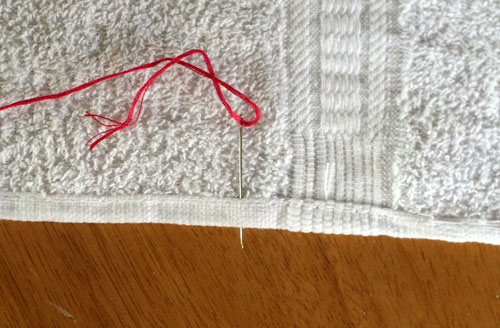
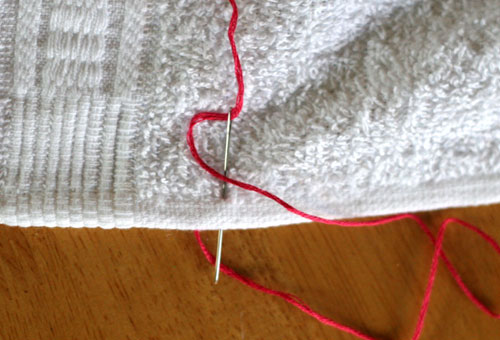
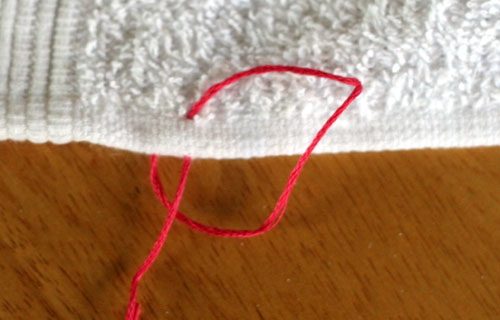
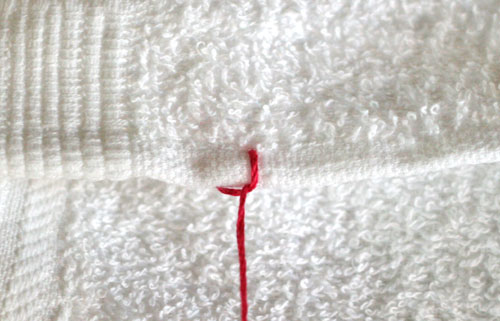
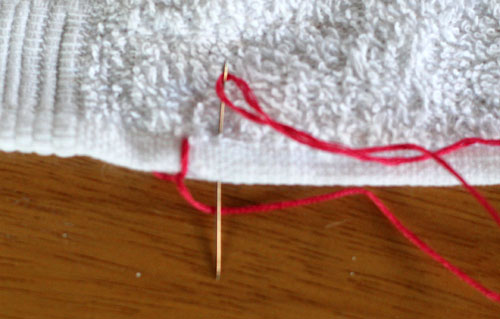
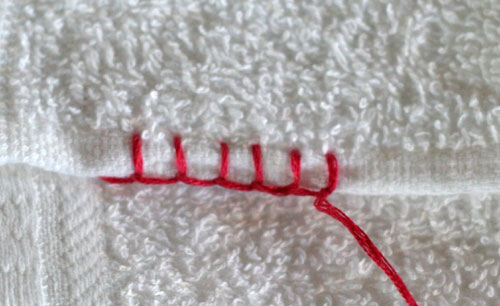
First, Run a needle and thread in and out evenly very close to the trim and draw it to the tightness of gathering you like. I loved this towel because it had the rust colored trim on the top and bottom already.

fruity-apron-4.gif<

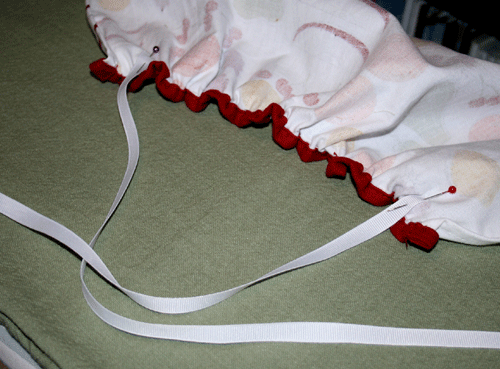
Then pin your ribbons (20") in place and sew over the gathering, making sure it IS wrinkled under the needle and that the fabric doesn't flatten out. I also burn the edges of the ribbon with a lighter so that is does not unravel, very lightly so you don't change the color of the ribbon.

fruity-apron-3.gif

Last, I measured 2 ribbons 28" inches long and measured where at my waist I wanted to tie the apron. Again, I burned the ends of the ribbon and pinned them into place along the back right and left edges of the towel and sewed just over the ribbon, along the original towel seam.
Voila! So cute and automatically comes with a matching towel! This would be a great, quick, housewarming gift!
If this fruity set is perfect for your kitchen I have a couple of sets available
here!

Lesson 5

Thursday, September 20th, 2007

No, I didn’t forget to post Lesson 5 for the embroidery school - my computer pooped out earlier this week, and for anyone who’s had that happen knows it’s a tiny bit stressful! But my sweet hubby is letting me borrow his so I can wrap up with this final lesson. The original plan was to finish with four new stitches, however one of them was a bit difficult and I was getting frustrated on how to execute it properly, so we will finish with three. Because my handy-dandy design software is also on my computer, there is no new homework design for this week - so sorry (that’s actually my favorite part of the lesson - doing the design). So without further ado, Lesson 5.

Stitch #13 Scroll Stitch

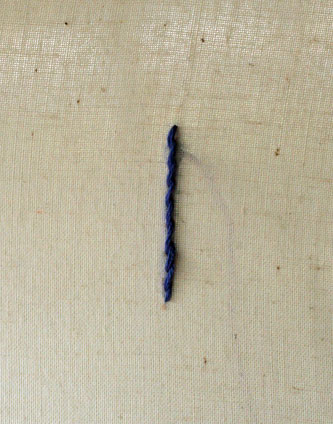
This is a great stitch to complement borders or fillers for designs. I didn’t do this for the tutorial, but it helps to use one of your ink pens to draw a line so your scroll stays even.

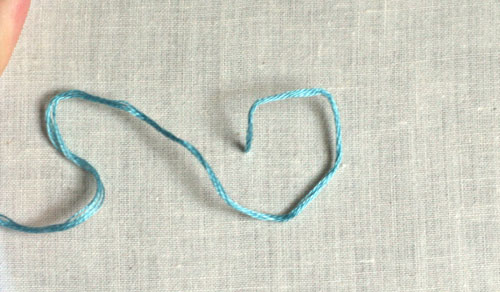
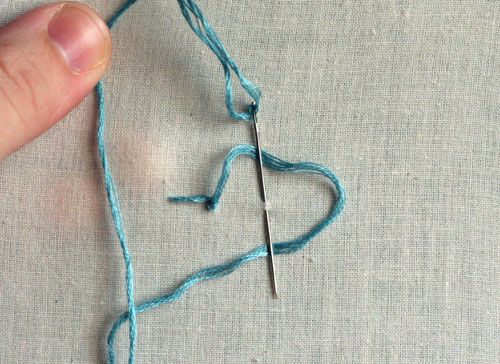
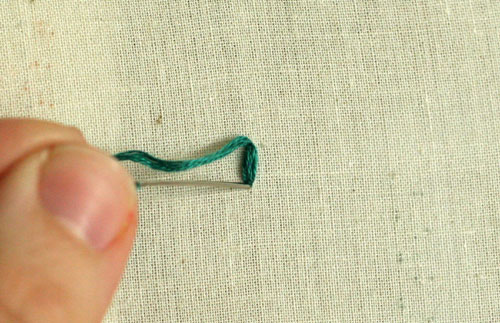
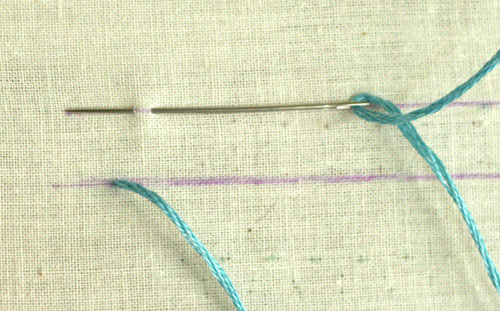
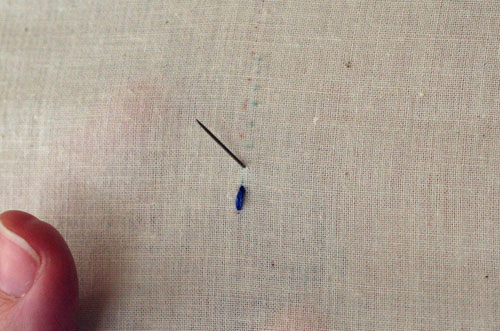
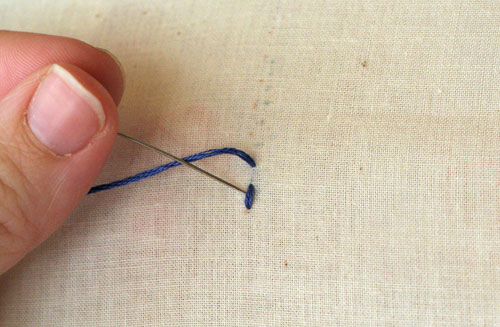
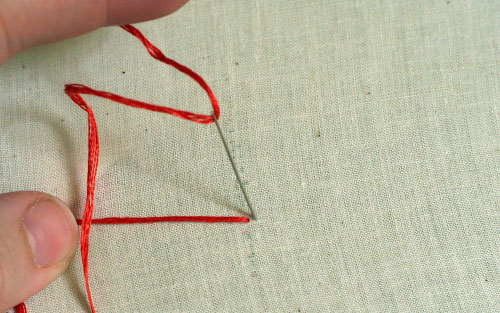
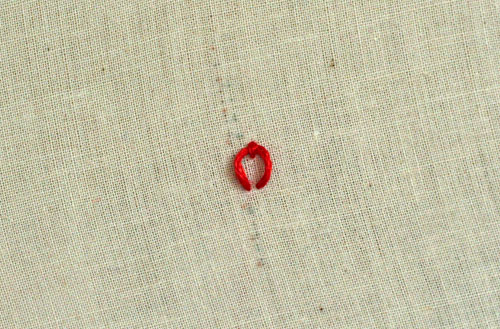
You’ll begin by bringing your needle and thread up to the front. Once your thread is pulled all the way through, you’ll make a loop that falls to the right of where your needle and thread came up.

em1.jpg

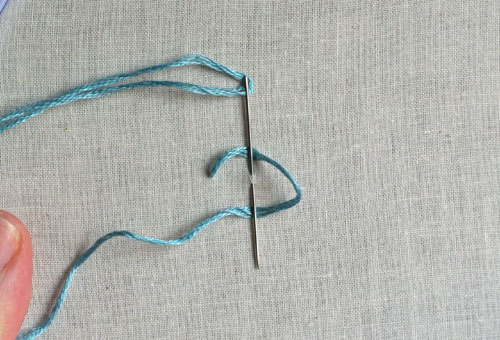
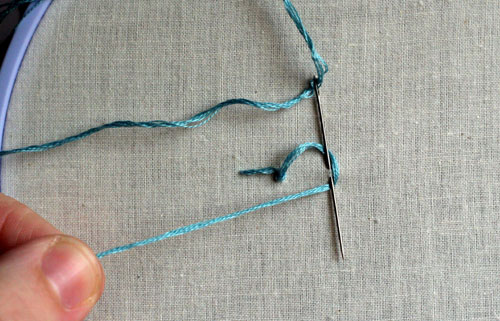
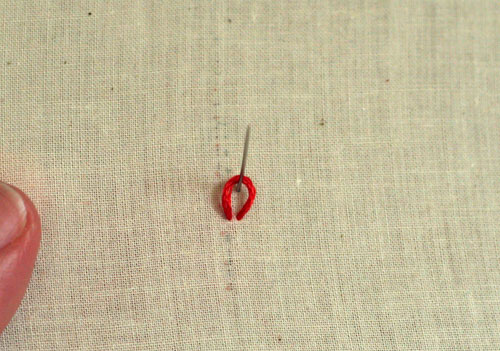
You’ll then place a stitch about 1/2″ away and level with where you came up to begin, going down and then back up. Make sure that your needle is sitting on top of your thread.

em2.jpg

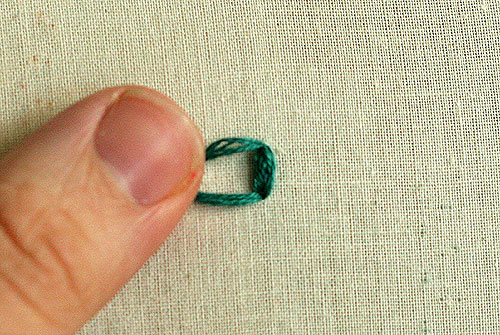
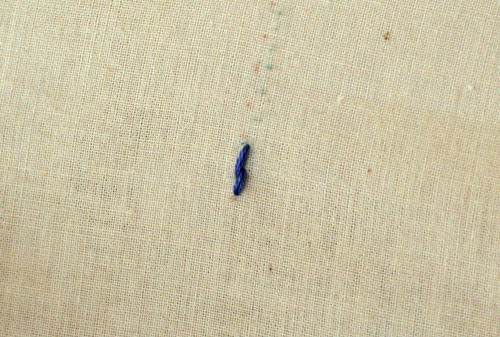
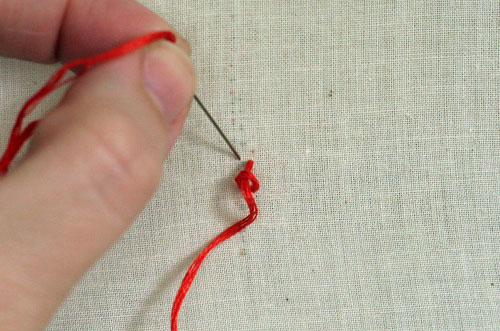
Then you’re going to the hold the thread taut between your thumb and your forefinger as you pull the needle and thread through.

em3.jpg

em4.jpg

em5.jpg

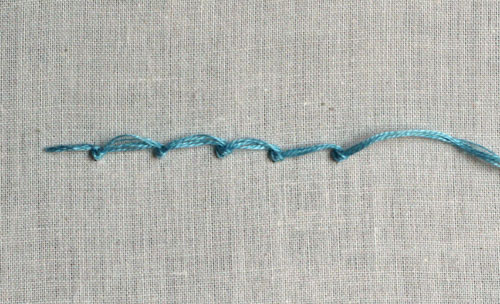
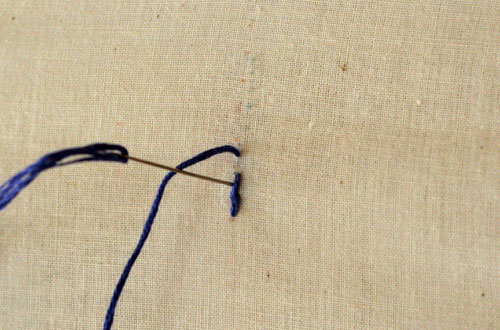
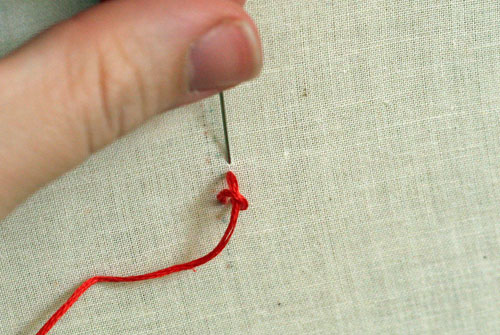
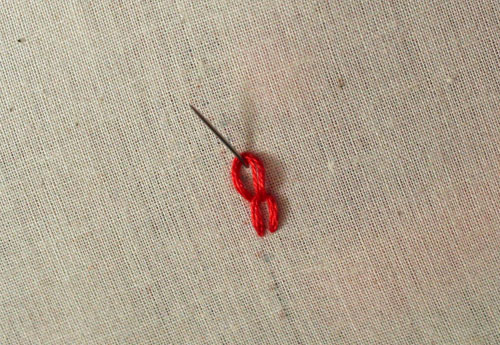
To continue, you’ll do the same thing again - make a small loop to the right, place a small stitch, hold thread taut while you’ll pull the thread through.

em6.jpg

em7.jpg

em8.jpg

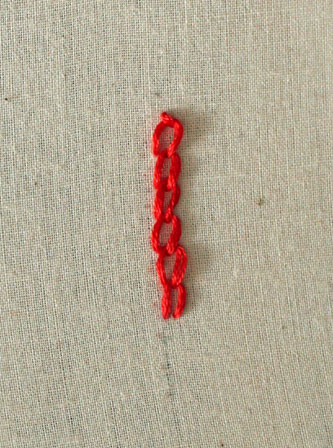
You’ll continue doing that until you achieve the desired length.

em9.jpg

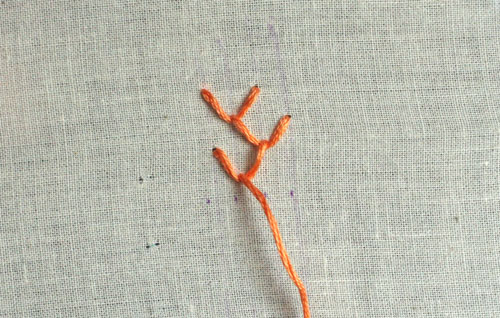
Stitch #14 Feather Stitch

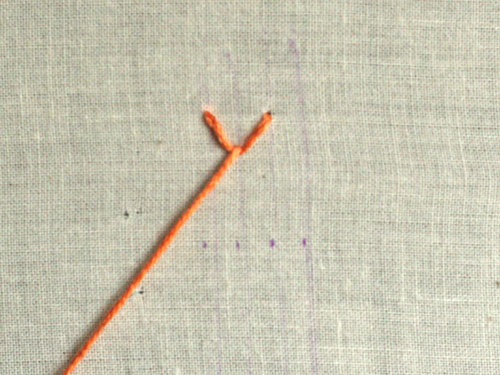
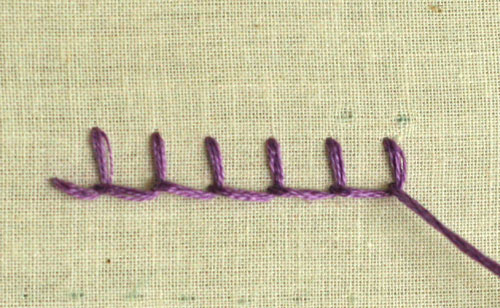
While this stitch may not look visually appealing (atleast to me it’s not), it’s actually really fun to do. You’ll see this stitch edging blankets and for crazy quilting as well.

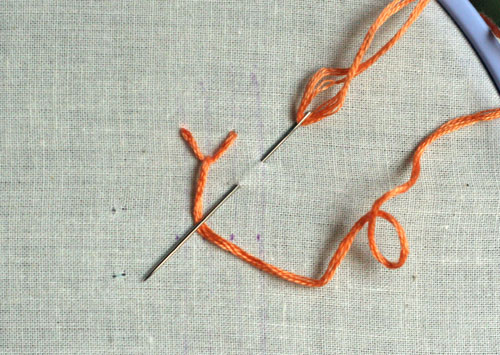
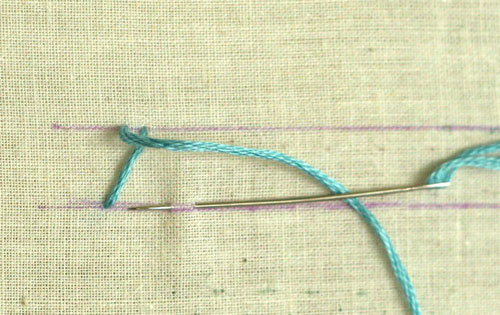
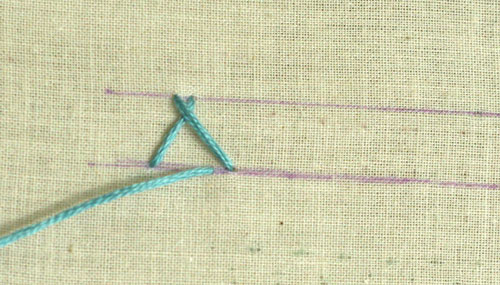
I apologize for my lines not being the clearest (it’s amazing what doesn’t show up on a photograph at times), but you’ll start by drawing four lines parallel to one another and the same distance apart (between 1/4″ to 1/2″). You’ll bring your needle and thread up at A on the first line. You’ll then place your thread down at B on the third line and level with A, and up at C (you can do this individual or as one action, as I have in the picture) on the second line about 1/4″ to 1/2″ below A & B (so it’s diagonal to both points). Make sure that your thread is under your needle as you pull the thread taut.

em10.jpg

em11.jpg

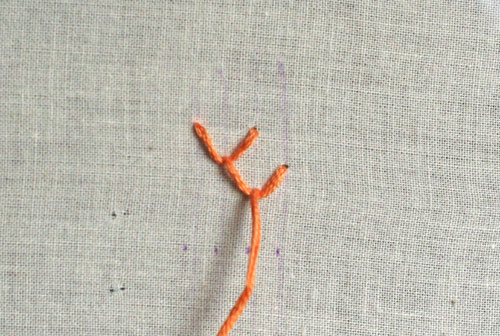
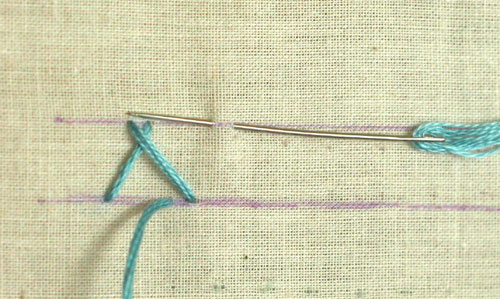
You’ll then do the same pattern, except you’ll move to the fourth line and you’ll go down at D (level with C) and up at E (diagonal to D and directly below B, making sure your thread is under the needle as you pull taut.

em12.jpg

em13.jpg

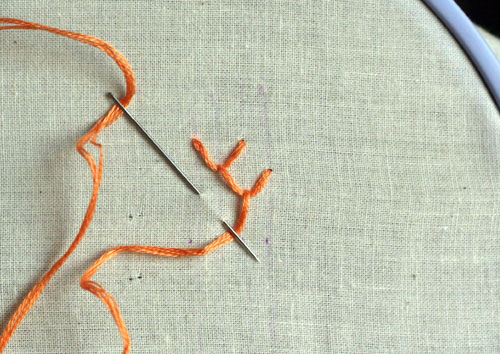
You’ll then move back to the first line, going down at F (even with E) and up at G (on the second line, directly below C), again making sure your thread is underneath the needle as you pull taut.

em14.jpg

em15.jpg

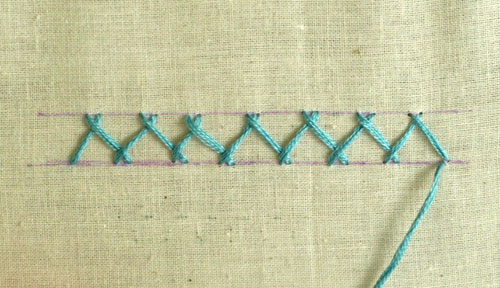
You will keep repeating the pattern until you’re at the end of your line, planting your final stitch just under where you came up.

em16.jpg

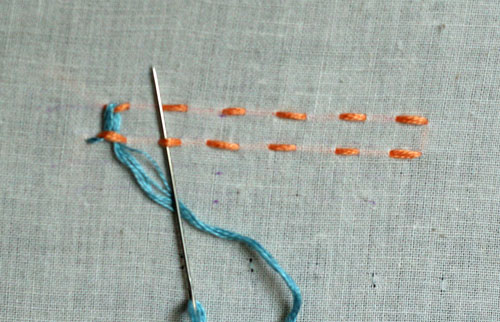
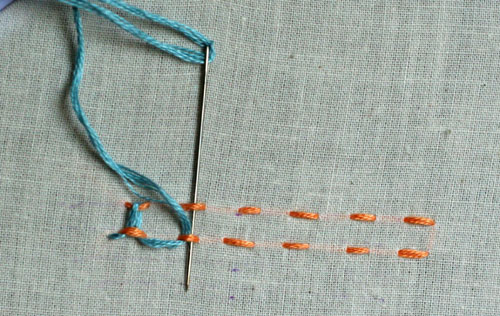
Stitch #15 Interlaced Double Running Stitch

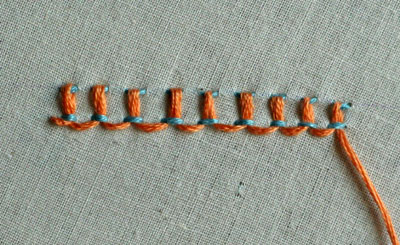
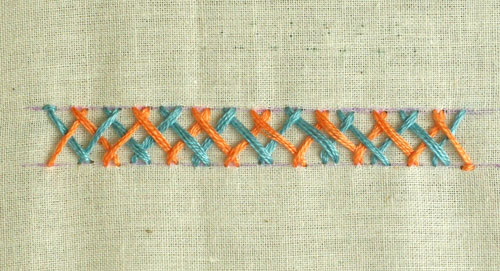
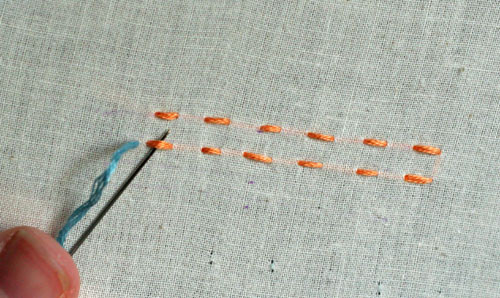
This stitch isn’t a common one and you may not like it, however I like how it’s so simple and adds a fun element to your needlework. You’ll start by doing two rows of running stitches that are identical in spacing to one another. The key for this stitch to look good is making the running stitches small and the spaces between short (as you will see that my final picture looks different than the first ones). It also helps to draw two parallel lines when completing the running stitches so they stay even.

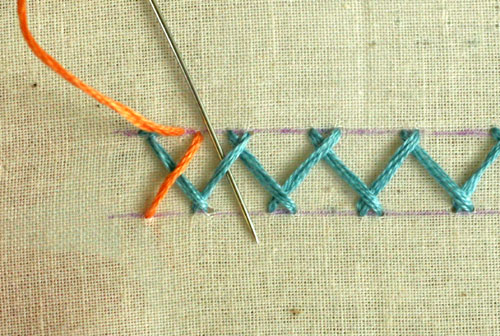
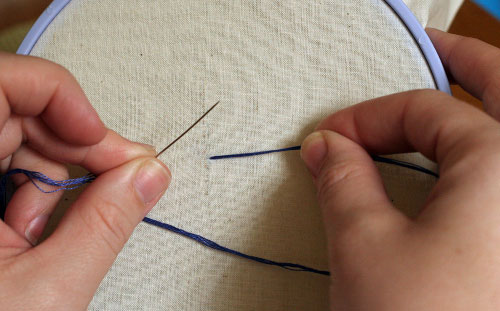
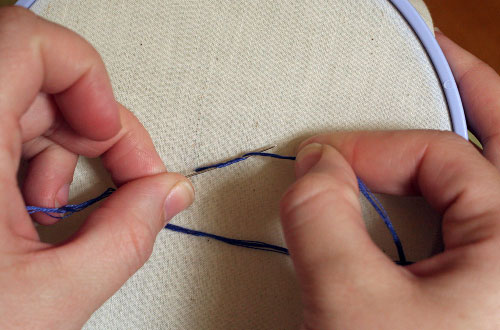
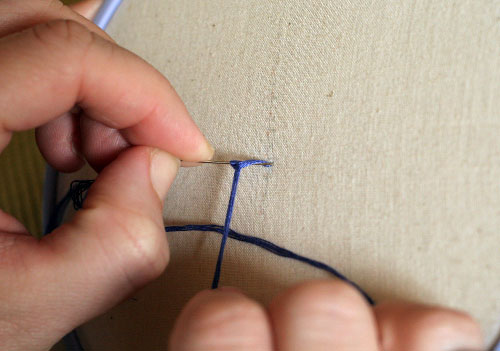
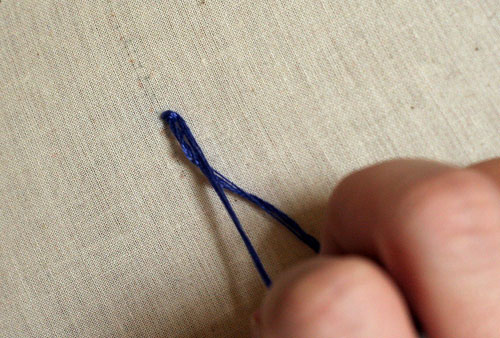
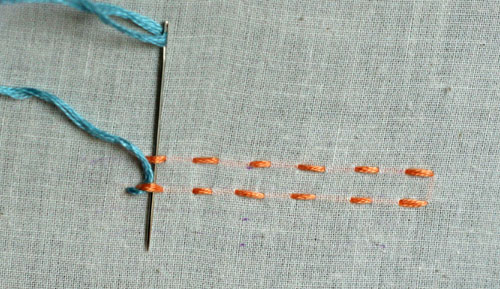
You’ll start by bringing your needle and thread up just beside the first running stitch on the bottom line. You’ll then slip your needle underneath the first running stitch (but don’t go into the fabric) and bring it through.

em18.jpg

Then, you’ll slip your needle overtop and then underneath the top running stitch and then back down underneath the bottom stitch (again, not going into the fabric).

em19.jpg

You’ll continue in the same across all the running stitches until you’ve completed the design.

em20.jpg

em21.jpg

em22.jpg

To finish, place the final stitch to the right of the last running stitch on the bottom line (not pictured - didn’t realize that until just now).

Now congratulate yourself for making it this far! Embroidery can be such an easy and fun way to personalize anything and my hope is that everyone who has been following the lessons continues to “school” themselves on it. There are so many great books and resources online (Primrose Design & Sharon B, just to name a few), so keep going and keep challenging yourself. And for those who turn in any completed homework (candace@craftydaisies.com) from lessons past by next Wednesday (if you already have no worries, you’re included), your name will be tossed into the hat to receive a goodie box of embroidery fun. For those who have turned homework in from last week, I’ll post them all at once when they’re all received next week. Thanks so much for everyone who supported this - I hope you enjoyed it just as much as I did!

Lesson 1
Lesson 2
Lesson 3
Lesson 4
Extra Homework

Sewing Even Corners

Thursday, September 6th, 2007

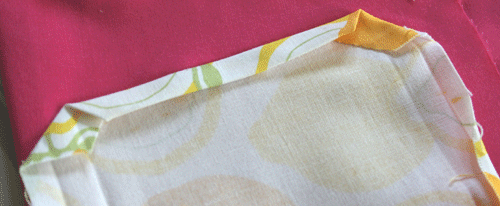
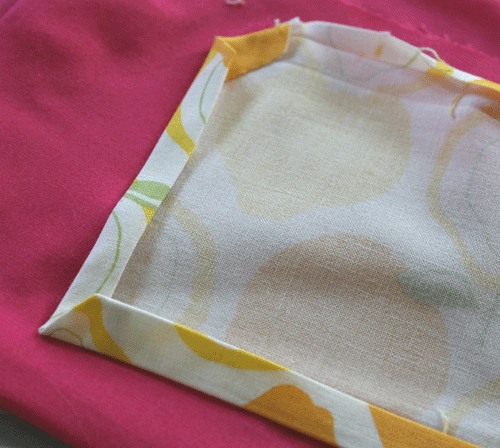
Can you notice a difference between the corner on the left and right?
corner0.gif

In an attempt to go a little more green around our house I decided to make up a bunch of cloth napkins in fabrics I liked. The only frustrating part was trying to press, pin, and sew corners that never came out straight. There is always that little corner that sticks out like a tongue at me! Until I learned a better way to fold and sew them, (Thanks Mom!) and I wanted to share tips from my sewing misadventures with you.

1. Snip off a little diagonally in each corner. (You may find this step in unnecessary but it ensures a neater fold as you get to Step 4.)

corner1.gif

2. Pretend that you have not snipped the corner and fold and press a 90′ “triangle”. You want this to be the width of turning your fabric over twice the width that you desire.

corner2.gif

3. Now turn the edge over two times until the sides and ends match up to peak at a perfect triangle. This may take a little trial and error. You can see where I pressed the sides and unfolded the edge again.

corner4.gif

corner5.gif

4. I use an iron to do a lot of my sewing. Ironing really helps you to get your hem straight and with no pins! So once you have this lined up just right you can just sew across your hem.

corner6.gif

I feel great when my homemade napkins look just as good as the ones I have bought! Great for tablecloths, tablerunners, placemats, etc. too.

Embroidery: Lesson 4

Wednesday, September 5th, 2007

Today will be the last day of basic stitches, and the final two weeks we’ll be doing a few more advanced albeit beautiful stitches. The ones we will cover today aren’t that common, but they are easy and are great finishes and accents to designs. One thing I do want to say is people are still having trouble with french knots. While they do seem easy, you must practice them and it may take awhile. The key is to keeping the thread taut into your fingers after you wrap it around the needle and are pulling it through the fabric. If you aren’t holding it tight enough, it will unravel, or knot prematurely. Some people offered Heather Bailey’s instruction on doing them and said this way works wonders, and you can find that here. If anyone has any other suggestions (besides the ones that are in the comments for Lesson 2), please let me know - I’d love to post them since french knots are beautiful and almost essential to embroidery. Now, Lesson 4.

Stitch #9 Granitos Stitch

This stitch is complementary to the satin stitch (that we covered last week) as another way to fill certain shapes. They’re also great to do as leaves or petals instead of the lazy daisy (covered in lesson 2). This stitch is the same stitch in the same direction, coming and going in at the same point over and over. Sounds simple? That’s because it really is.

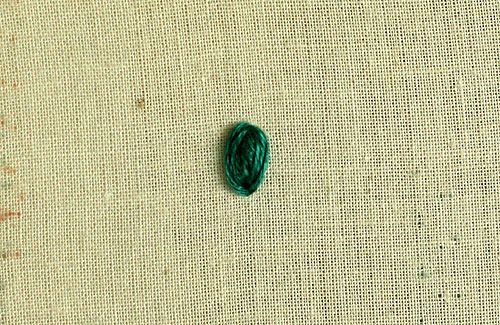
You’ll start by making a simple straight stitch (up at A, down at B). You’ll then bring your needle back up in the same hole as A and bring it back down in the same hole as B, pulling the thread all the way through, but so it goes to side (it helps if you hold the loop with your thumb as you’re pulling it through to make sure it lays beside the stitch and not on top of it).

embroidery1.jpg

embroidery2.jpg

embroidery4.jpg

You’ll continue alternating sides until you’ve reached the size or fill that you need. For this picture I did four stitches on both sides.

embroidery5.jpg

Stitch #10 Blanket Stitch

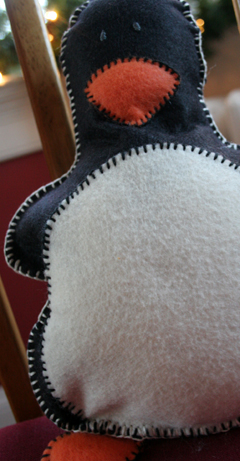
This is a great stitch to border items such as blankets (go figure), shirt collars, and also joining items together. The blanket stitch was the only stitch used to piece together this felt penguin.

finished-penguin2.jpg

You’ll begin by bringing your needle up at the base of your work, or where you’ll need it to be lined up (at A). Next, you’ll bring your needle down at B, diagonal to point A, and then up at C, which will be beside point A (about 1/4″ away). You’ll need to have the thread looped underneath your needle when you come up at C, or else this stitch won’t work.

embroidery6.jpg

embroidery7.jpg

Then you’ll pull the thread taut and you have a backwards “L”.

embroidery8.jpg

You’ll do this over and over until you get to the end of your edge or completed the length that you need.

embroidery9.jpg

embroidery10.jpg

When you’re done, you’ll take the needle through on the opposite side of where you came up for the last time, planting that stitch and leaving your thread behind your work.

embroidery11.jpg

When doing this stitch on the edge of a garment or piece of fabric, you’ll execute in the same fashion, starting on the backside of the fabric. Take the needle and go down through the hem vertically (at A), turn your fabric over and go down at B (diagonal to A) and through the hem vertically, like you did at A.

embroidery19.jpg

embroidery20.jpg

Make sure that your thread is looped behind/underneath the needle as you pull the thread taut.

embroidery21.jpg

embroidery22.jpg

Continue until you reach the end, planting your stitch when you’re done.

embroidery23.jpg

embroidery24.jpg

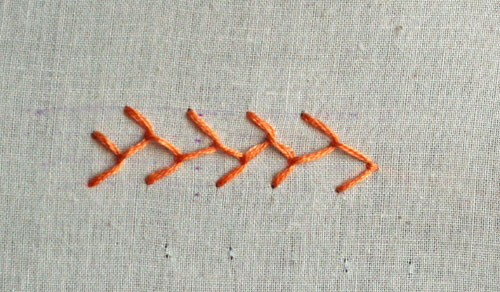
Stitch #11 Herringbone

These last two stitches aren’t the most common or the most used, but I love them, especially as a border for a garment or as a border within the design.

First, you’ll want to use one of your ink pens to draw two parallel lines on your fabric. You’ll bring your needle and thread up at point A on the base line. You’ll then take your needle up and diagonal to A and insert it at B and out at C (moving right to left as shown in the picture). You can actually go in at B, pulling the thread all the way through and then up at A, making two seperate actions, or you can do like I have done in the picture.

embroidery12.jpg

You’ll then move to the base line, put your needle through at D, diagonal to B & C, and out again at E, still moving right to left.

embroidery13.jpg

embroidery14.jpg

You’ll continue working this way until you reach the end of your lines.

embroidery15.jpg

embroidery16.jpg

You’ll also end this the same way you do your blanket stitch, and that’s to take the needle down beside the last point you came up, leaving your thread behind your work. Now if you want to add another element to it, you can now incorporate the double herringbone stitch.

Stitch #12 Double Herringbone Stitch

You’ll basically use a contrasting thread color and do the exact same thing in between the original herringbone, except starting at the top line instead of the base. You’ll work in the same way, except you’ll alternate taking the thread behind the original stitch (so you’ll go over then under, over then under, etc).

embroidery17.jpg

embroidery18.jpg

Lesson 4 Homework

Continue working on all the stitches so far on this week’s design template. I left the dress plain so that you could use any stitch you like for embellishment on it. I can’t wait to see what everyone does!

How to Square Bags

Friday, August 24th, 2007

I had been asked by several to explain what I meant by the term “gussetting” in several of my former projects. It’s one of those techniques that is difficult to describe in words but is really easy to do! I promise if you try this quick tutorial it will change the way you sew, especially the way you make bags!

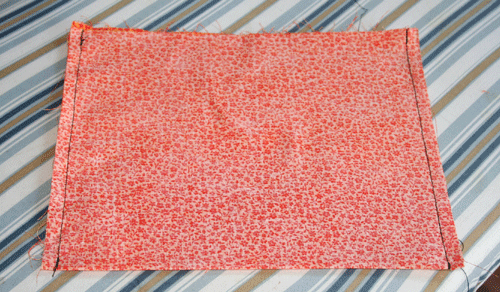
1. For my example I made a small pouch by folding my fabric in the middle (right sides together) to make the bottom of my bag, and sewing up the right and left sides.

square-1.gif

2. Then at one of the corners I put my hand inside of the bag in order to flatten it in the opposite direction.

square-2.gif

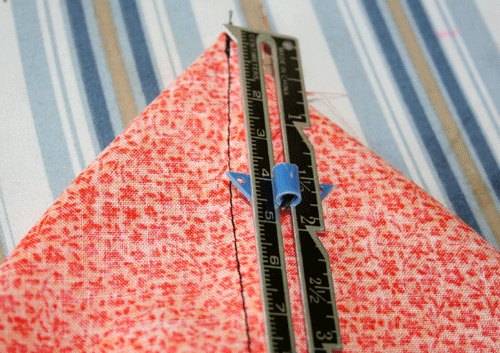
3. Now you are looking at the end of your bag and it should look like a triangle. Center your seam between the other 2 sides of the triangle and measure down from the peak the measurement of half the width you want the bottom to be when finished. Not hard math- 1 1/2″ if you want a 3″ wide bottom…it will depend on the size of your bag.

square-3.gif

4. Using ruler, mark with pencil or chalk a vertical line across your “triangle”. This the line that you sew your seam across.

square-4.gif

5. Repeat for the right and left sides of the bag. This is also how you could make ears on hats for kids, but by sewing on the right side of the fabric.

square-5.gif

6. When you turn the bag inside out it will have 2 square sides. Cover cardboard and add to the bottom to make your bag sturdy. This same technique can also be used on knitted bags, which is were I first learned to gusset.

square-6.gif

Embroidery: Lesson 2

Tuesday, August 21st, 2007

Thanks for all the great feedback! I’m glad everyone is understanding the directions and enjoying the lessons. One thing I didn’t clarify last week is when I talk about point A, B, C, D, etc. This just means the points at which the needle and thread passes through the fabric. Does that make sense? Now it’s time to move on to lesson 2.

Stitch #4 Stem Stitch

This is another great outlining stitch, particularly when you need to stitch a stem (ha) or a rope or string. It’s very easy and can be done quickly.

First you make a stitch (doesn’t matter if you’re moving up or down, or side to side, just bring it up at A and down at B). Then you’ll bring it up (point C) directly above or beside where you put point B in and bring it down in the middle and to the side of your first stitch for point D. This is almost like the back split stitch, except you’re not splitting the stitch, you’re pushing the stitch a little to the side and planting your stitch.

embroidery16.jpg

embroidery21.jpg

embroidery31.jpg

Then you just continue on your path and voila! A stem stitch.

embroidery41.jpg

embroidery61.jpg

Stitch #5 Detatched Chain Stitch

This stitch is also know as the petal stitch or lazy daisy, and it’s fun because it’s easy and it’s pretty. This is the stitch you’ll use to make flowers, leaves, tears, and raindrops. Also changing one part of the stitch turns it into a different one, which we’ll cover at the end.

First you’ll bring your stitch up at A and down at B (directly beside A) but don’t pull your thread all the way through.

embroidery141.jpg

You’ll leave some of the thread to make a loop, and once you get the amount you need, you’ll hold the loop down with the tip of your finger, while you then bring the needle up just below the center part of the loop at C.

embroidery151.jpg

Then you’ll bring your needle and thread up and then back down just above point C and complete the stitch at D. (I moved the loop down a little so you could see where to put your needle in)

embroidery161.jpg

embroidery171.jpg

If you want your chain to be a longer and thinner one (when making a leaf, per se) then feel free to tug a little harder on the string at point D to draw it taut. But if you want a soft, round effect, pull gently at D.

Stitch #6 Chain Stitch

Altering the detached chain slightly can give you the chain stitch. You’ll complete everything the same, except instead of putting your need down for point D directly above point C, you’ll move it to the side slightly. As you pull your thread through, the same thing goes as don’t pull the thread all the way through.

embroidery181.jpg

embroidery19.jpg

You’ll hold the loop with the tip of your finger so you can bring the needle back up at E, and back down at F, directly beside E. Continue until you’ve achieved the length of chain you need.

embroidery20.jpg

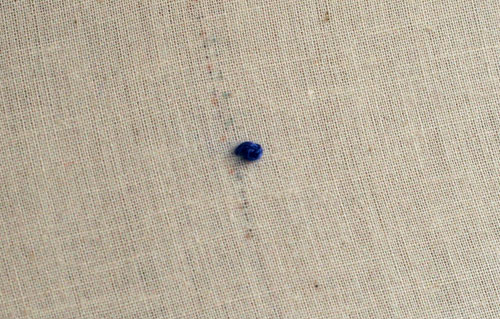
Stitch #7 French Knot

I used to dread this stitch until I was taught how to do it correctly and now it’s a breeze. This stitch is perfect for finer details in stitching, and when bunched together can have a really cool effect (like the lei on Kiki).

Start by bringing your thread up at A. Then you’re going to hold the string tight between your pointer finger and thumb, and face the needle point away from the fabric (I do appologize that I am left handed - if this confuses you, let me know and I’ll flip the picture).

embroidery71.jpg

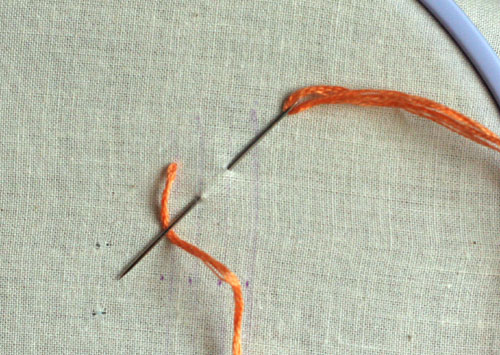
Then you’ll wrap the needle 2 to 3 times around the thread (twice will give it a small knot, 3 a bigger, and anything larger than 3 is bordering on becoming a bullion) - for this picture, I did it three times.

embroidery81.jpg

Then place it directly beside where you made point A. Do not put it into the same point as A. Some people say that’s the correct way to do it, but I find it’s much easier this way and you won’t lose your stitch by going back down through the same hole.

embroidery91.jpg

Continue to hold the thread taut while you’ll pull it through at point B - that’s your key for this to be successful.

embroidery101.jpg

Once all the way through you have a cute and easy french knot.

embroidery111.jpg

Your thread may get hung up and not go all the way through, so gently tug on it to pull the remainder through. As easy as this stitch can be, it takes some practice, so practice it before you try it on a project.

Lesson 2 Homework

I’ve attached a PDF of an image that you will embroider using one or all seven of the stitches I showed you. click here to download and stitch all of the image, or just certain parts. Since I can’t send every one of you following this an iron-on transfer, you can do what I do when transferring an image - I trace the image onto an index card (from the computer monitor), run over it with a black marker so it’s darker, place it under my fabric and then trace it again onto my fabric with my disappearing ink pen. I do this because I don’t have a printer at home, but if you do, skip that first step and just print it out, place under your fabric and trace. I would love to see some finished projects when you’re done so please email them to candace[at]craftydaisies[dot]com. And as always, if you have any questions please feel free to let me know. Can’t wait to see how you all do!

ETA: For those who had problems downloading the PDF, refresh your page and try again, it should be working now.

Embroidery: Lesson 1

Tuesday, August 14th, 2007

Thanks to everyone who expressed interest in learning how to embroider. This school will last six weeks, and we’ll go over all the basics of materials used and most common stitches. For those who know a lot about this know that there are over 400 embroidery stitches, so needless to say we won’t be covering every one of those. But we will be learning the ones you’ll see (and use) most, and in doing so it will also be giving you the confidence to continue learning them if you choose to do so. Anyone who sends me a finished embroidery project at the end of the school will recieve a goodie box full of embroidering fun. So without further ado, lesson 1.

What is it and Why do it?

Embroidery is the art or handicraft of decorating fabric or other materials with designs stitched in strands of thread or yarn using a needle. My grandmother taught me how to embroider when I was about seven years old, and I would often watch her hand-stitch designs on the many quilts she completed. There really is something beautiful, unique and romantic about embroidering by hand, so while you can have a machine stitch something up for you beautifully, if you have the time (and the patience) and are willing to give it a go, you really should try it.

General tools needed and used

Embroidery can be an inexpensive craft to learn, but so are most things. You can certainly get caught up in the cool new gadgets that are out there, but the only things you really need are material to stitch, a hoop, a needle, a pair of scissors, and embroidery floss. Depending on what you already have, you will only spend about $10 to get started.

Needle: Any needle that will accomodate your thread will do. In our lessons, we’ll be using 6-stranded embroidery floss, so a basic embroidery needle will be fine.

Hoop: This can be a cheap wooden hoop, or a heavier plastic. And it’s actually two hoops: one side is adjustable, the other is not. You will stretch your fabric across one piece and secure with the other, tightening or loosening it if neccessary. You don’t need to work with a hoop (and in some instances it will be almost impossible to use one) but I assure you it will make it so much easier to stitch, and it will keep your stitches from puckering up.

Scissors: Again, any that you already have should be fine. However having a small pair of embroidering scissors on hand that will help you cut easier and with more precision when you need to snip around stitches.

Embroidery Floss: The easiest floss to work with is 100% cotton, colorfast (meaning it won’t bleed when you wash it), and is six-stranded. You can buy this at any craft store anywhere from $.20 to $.40 a skein. You can also find it in almost any color, giving you another reason to love embroidering.

Material: I am a firm believer in you can stitch on just about everything…just be prepared for a fight at times. For this course, however, I suggest using any kind of 100% cotton fabric that does not have a tight weave (i.e. linen, flour sacks, tea towels, pique, and muslin, which I highly recommend since it is easy to work with and is very inexpensive). You’ll want to wash your fabric first, and iron it if necessary. If you have any scrap fabric lying around, you most certainly can use it, esp. for practicing and save the nicer pieces for projects you want to display.

Water-soluble or vanishing ink pens: You’ll find these in the quilting department of any craft store, and while they can be harder to use on some fabrics, they can be your best friend when you can’t find a pattern you like. You can draw on the fabric and depending on which you get, you just remove the ink with a wet washcloth, or wait 24-36 hours for the ink to disappear. They aren’t that expensive, so while this is an optional tool, I recommend it if you have some original designs in mind but don’t trust yourself to stitching free-hand.

Optional Items:

Thimble: These things drive me bananas, so you will not see me using one. However some people insist on them, so I’m just putting this out there that you might want to try using one. If your finger does get sore from pushing and pulling the needle and a metal or porcelain thimble doesn’t work for you, you can always try a rubber one, which feels a little more natural and comfortable to use.

Needle threader: You can get a pack of these for around a dollar at most fabric and craft stores and they can be incredibly useful. It does exactly what it says: it’s threads your needle by sticking a bendable “eye” of the threader through the eye of the needle. The threader “eye” is large enough so you just slip your thread through it and pull it back through the eye of the needle and voila! A threaded needle. I tend to get overzelous and excited when starting a new project and end up breaking them, so it’s just a step I like to skip. However, if this is the part you hate the most, then by all means invest in some of these beauties and skip the frustration all together.

Fusable interfacing: Honestly, I never use this stuff. I tried once and it just irritated me so badly, but truth be told I’ve never been taught how to correctly use it. I do know that it has a purpose (to smooth out your project, make it sturdier, and prevent knots from unraveling), but I also know it’s more trouble than it’s worth (over time will stain the fabric, become brittle and break off, and will pucker at certain places in your work). So why include this if I’m not going to even talk about it or suggest you use it? Good point, I don’t know. I just didn’t want anyone who believes that this stuff is the holy of holies to think ill of me that I didn’t mention it. And on that note, if anyone wants to make an argument for why this stuff should be used, please let me know and we’ll put it in this section.

Now it’s time to begin!

1) Position your fabric within the hoop. You’ll need to seperate the pieces and lay the piece that does not have the adjustable part on it on your work space. Place your piece of fabric overtop, then place the other piece of the hoop over it and push down on it so it stretches the fabric over the bottom piece, much like the head of a drum. You can tighten or loosen the top piece as much as possible, and you’ll want to pull the fabric taut so it creates a smooth, even work space.

2) Cut your thread to 12″ or 13″. This may not seem like much, but you can always use more when you run out, and working in smaller increments will keep your thread from tangling and will keep you from raising your arm high above your head to pull all the thread through the material.

3) Thread your needle. You can use a needle threader or you can do the spit-and-flatten technique (not an actual technical term, but it’s pretty self explanatory) - lick the end of the thread and flatten it with your fingers (to stick all the strands together), thread your needle, then knot the other end. Doesn’t have to be any fancy knot, just something large enough not to pass through the material and small enough so it won’t create a large bump under your fabric.

Now it’s time to stitch!

The stitches we will be covering today are super easy and three of the most basic stitches you’ll see in embroidery. Please forgive the coloring of the photo’s - I took them at the worst part of the day, in a room with bright yellow walls, so if they’re blown out or miscolored on your monitor, please let me know and I’ll try to fix them.

Stitch #1 Running Stitch

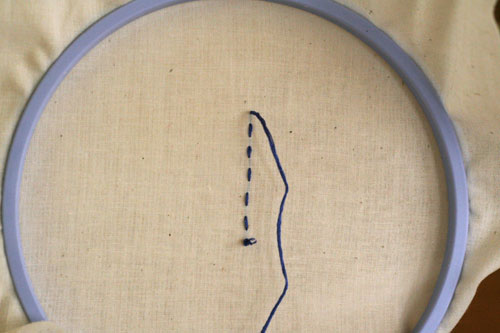
This is the easiest stitch to complete. You can use it to outline items or run along an edge, and there are two ways you can do it.

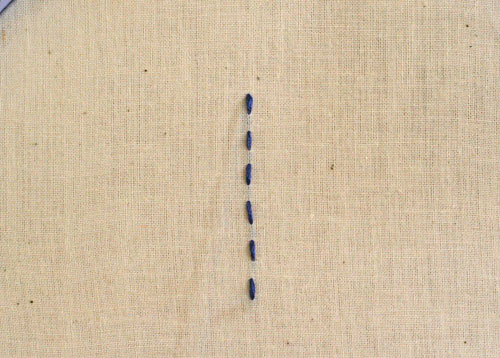
First, you bring your needle up through the material at point A and then back down through at B. You do this again (coming up at C, down at D), however you’re leaving a space in between each stitch, creating a dotted-line effect.


embroidery1.jpg

embroidery2.jpg

embroidery3.jpg

The back side will look exactly as the front
embroidery4.jpg

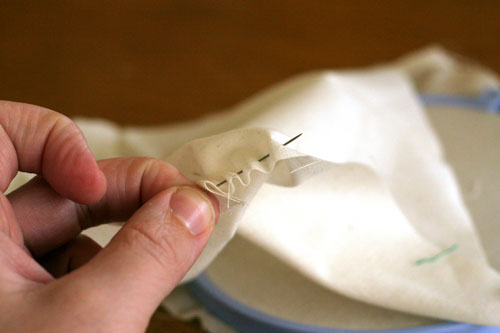
The other way to complete this is to gather your material and run the needle through in one seamless motion.

embroidery5.jpg

embroidery6.jpg

If you’re new to embroidery and unsure of yourself, you’ll probably be most comfortable with the first way. However, if you’re feeling adventurous or are more confident in your stitching, or want to create something that looks a little uneven but unique, then the second technique is the way to go.

Stitch #2 Back Stitch

This stitch is my personal favorite. Not only because it is quick and easy, but because it looks great (and clean) any way you use it. It’s also a great stitch to complete lettering with. The one thing to remember with this stitch is you’re almost working backwards, in a sense.

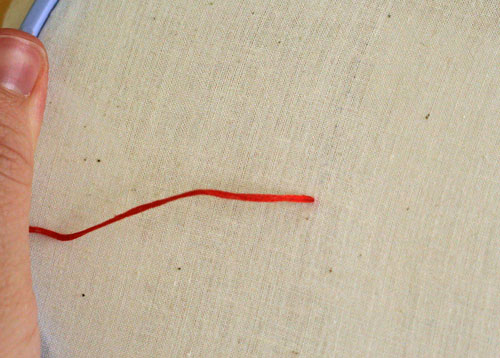
First you’ll bring your needle and thread up through the material, but at point B instead of A
embroidery7.jpg

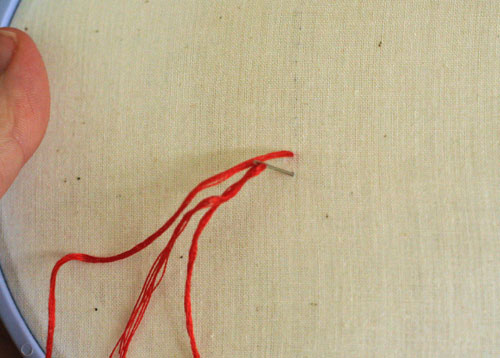
Then you’ll bring it back down through, but in the opposite direction you’re wishing to go (hense the backwards part I was talking about), putting it at point A.
embroidery8.jpg

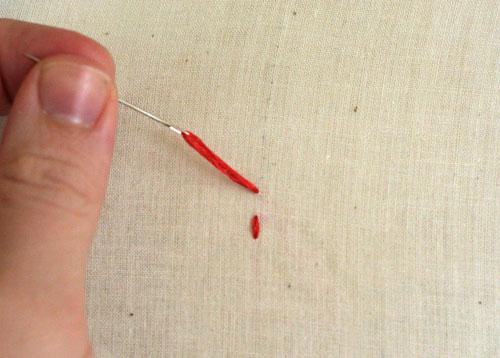
You’ll then keep going in that direction or bringing your needle up at point C, then back through at B, then up at point D then back through at C, etc. etc.

embroidery9.jpg

embroidery10.jpg

embroidery11.jpg

By the end you’ll have a seamless looking line and your stitches will connect beautifully.
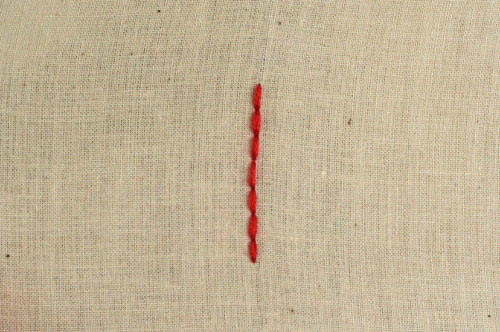
embroidery12.jpg

Stitch #3 Split Stitch

This stitch is easy and a decorative finish when you want something a little more punchy than the running or back stitch.

You’ll bring your needle up through your material at A and back through at B (like a regular stitch).
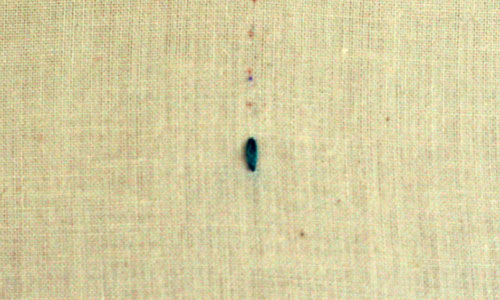
embroidery13.jpg

Next you’re going to split the stitch in the center (at C), so you’re splitting the threads evenly (or as evenly as you can)
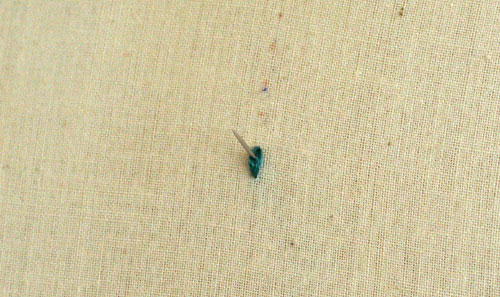
embroidery14.jpg

Then you’ll bring it back down at the desired point (D).
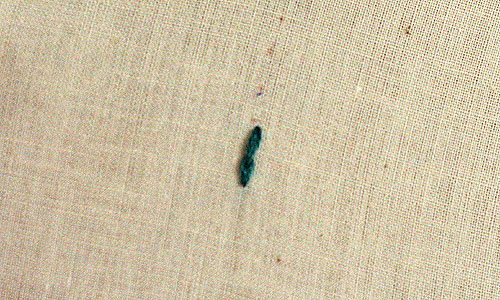
embroidery15.jpg

You’ll continue splitting each stitch, until it looks like this

embroidery18.jpg

One thing to remember about this stitch, is it’s easy for your thread to get tangled on the underside while you’re splitting the stitch. So this is very important that you work a little slower, and don’t use too long of thread.

You can also work this stitch a little differently, like the backstitch (calling it the split backstitch), by bringing up your thread at C and then splitting the stitch on the way down (from the top side of the frabric as opposed to the underside). Either way is fine, it just depends on which you’re more comfortable with.

My photo’s for this stitch are a little blurry, so hopefully this diagram will explain it where my picture lacks detail

split-diagram.jpg

If you’ve hung on through all that jibber jabber that’s great! I can promise you the next lessons won’t be so wordy, we just had to get the intro out of the way. If at anytime you have any questions or think I need to clarify a little more, you can leave a comment or feel free to email me at candace@craftydaisies.com.

Homework for Lesson 1:

If you have any scrap material, you’ll want to use it for practice this week. Draw a circle, a square, and any other shapes that you want on your material of choice and practice each stitch. If you haven’t gotten your pens yet or choose not to, you can use a regular pen or pencil, or do them free-hand. If you’re feeling confident enough, try stitching other images and letters using these stitches. It may sound simple enough - and it is - but like you’ve heard before, practice does make perfect. Next week we’ll go over three new stitches and I will have a PDF you can download and transfer onto your material to complete.

Pressed Flowers

Thursday, August 9th, 2007

One of the best things about summer is the flowers, don’t you agree? A fun way to keep them around past the peak bloom point (and for those in cold climates to remember the lovely summer colors) is to press them. You can easily make your own flower press, and here’s how.

Start with 2 squares of wood (approximately 8″ across), 4 bolts (approximately 4″ long), 8 coordinating washers, 4 coordinating wingnuts, and several squares of cardboard and felt, with the corners trimmed. I have 7 cardboard pieces and about 10 pieces of felt - these are used to separate the layers of the flowers you press and to provide cushioning.

flowers1.jpg

You simply drill 4 holes near each corner of each square and assemble: bolt, washer, one square of wood, cardboard, felt, paper, flowers, paper, felt, cardboard (etc), board, washer, wingnut. You add layers of plain white paper around the flowers to prevent them sticking to the felt, and it also allows for easy storage later on — I keep mine either in a folded piece of paper or inside envelopes. Screw the wingnuts on tight to press the layers together and compress your flowers. Then you wait for a week or so to allow the flowers/leaves to dry and flatten.

flowers2.jpg

Pay attention to the layout of your flowers and leaves when you are pressing - you want to make sure that it will look how you want it to when it’s flat. Leaves are easy, but be careful with multiple petal layers - sometimes they bend oddly when you press them, and the result is not pretty.

Simple flowers work well though. Pansies are gorgeous:

flowers3.jpg

I’ve also done marigolds, lilac, roses, several kinds of leaves, irises, even a butterfly. If your garden is large, you can have lots of fun playing around with the press and trying different layouts.

Once you have your array of pressed flowers, you can paste them into a frame:

flowers4.jpg

I just used regular Elmer’s and glued the marigold and the butterfly onto thick white paper (I think mine is designed for painting). Tweezers can be helpful in arranging delicate pieces, such as the butterfly - sometimes your fingers are just too sticky. These flowers would be lovely on cards, too, if you enjoy making your own. Let me know of other fun ways to use them - I’m just beginning my foray into paper crafts :)

This guest post comes from Gina - thanks so much for your contribution, Gina!

Sea shell shadowbox

Friday, July 27th, 2007

Hi, I’m Gina. As do many others, I have always loved the beach. Growing up in Minnesota, though, there are few opportunities to be in the ocean, so I guess I tried to take advantage of all of mine by bringing the beach home with me. Thus I have accumulated a lot of shells, beach rocks, coral, and other beachy finds from various trips, some with sentimental value. For example, one of the rocks I used in the project was from the spot on a rocky beach in New Zealand where my husband proposed.
There are lots of ways to display shells - on countertops, in bowls, etc. But I wanted a way to look at the special ones all at once without them taking up too much space or requiring much dusting. So I decided to create a seashell shadow box.

To begin, you need your collection of shells, your trusty glue gun, and a shadow box. Mine has a lovely dark wood frame and a neutral linen background that mimics sand:

shadowbox1_1.jpg

Next, you lay your shells in a pleasing pattern. You could go with a more random arrangement if you like, but I preferred to arrange them so that I could balance shape, color, and size:

shadowbox2.jpg

Then you glue! Most of mine were light enough not to require much glue, but obviously rocks or large, heavy shells will need more. Make sure when you’re gluing (and when you lay everything out) that your shells all fit when the lid is closed. One of mine (the large on in the bottom right corner) was oddly shaped and would only balance on one edge, so I paid attention to that while gluing to ensure I glued the correct edge.

shadowbox3.jpg

I love the finished product! I had tons of shells left over, but I liked keeping some space between the shells. I think a tighter arrangement could also be lovely, though.

shadowbox4.jpg

Here are close-ups of the shells and the linen background of the shadow box:

shadowbox5.jpg

shadowbox6.jpg

So have fun with your shells! I’m sure everyone has a collection of sorts that would fit nicely into a shadow box, even if it isn’t seashells.

Crayon Nibbles

Thursday, July 26th, 2007

crayon4.jpg

My son just turned 18 months, and is really into coloring. I absolutely love this because now we can be creative together. However, he is also a toddler (and a boy) which means most of the time breaking the crayons is often more fun than coloring with them. A friend of mine told me awhile back about melting down crayons to make chunkier ones that are easier for little hands to hold (and tougher for them to break). This is also a great way to use up broken crayons that you have laying around.

crayon1.jpg

What you’ll need:

  • Crayons (like I said, you could use ones you already have or buy some. I purchased 5 boxes of 24-pack crayons for 20 cents each - back to school bargains!)
  • mini muffin pan (one that you don’t mind getting a little crayon on)
  • exacto knife (optional)

You’ll want to preheat your oven to 265 degrees F. Peel off all the paper from the crayons (for the new ones, I found it much quicker to remove the paper in one smooth motion if I carefully ran the exacto knife down the center of the paper and peeled the paper back), and break them into 1/2″ to 1″ pieces. Arrange two to three like colors in each slot, then bake for 6-8 minutes (don’t over bake - you want them just melted so you can’t distinguish the crayon shape anymore). Let them congeal a little on the counter, then place them in the freezer until they are firm (approx. 30 minutes). They should then pop right out.

This is great for little hands that aren’t steady enough to hold thin crayons. They can wrap their whole hands around them and go to town without breaking them.

crayon2.jpg

crayon3.jpg

They also make great back to school and birthday gifts for other little artists in your life.

crayon5.jpg